This is the archive of my blogging about my time working with GBA Ships - the M/V Doulos and the M/V Logos hope.
Posts in chronological order for easier reading.
This is the archive of my blogging about my time working with GBA Ships - the M/V Doulos and the M/V Logos hope.
Posts in chronological order for easier reading.
We’re sailing again!

It’s so lovely being back at sea, and David seems to quite like it too. He actually slept right the way through the night the first night! Amazing… (If only he’d do it again…)
AV work is going reasonably well. We’re doi 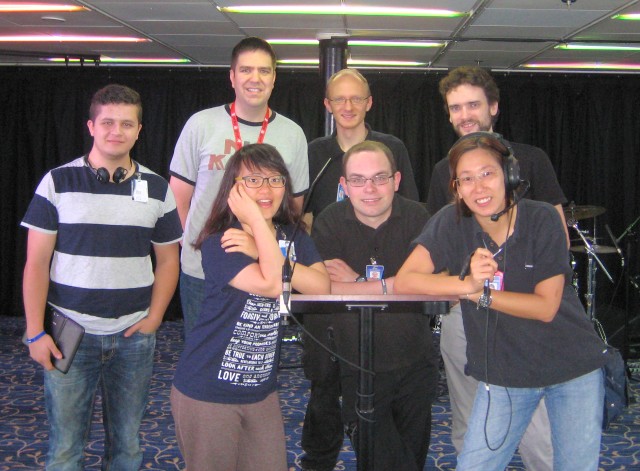
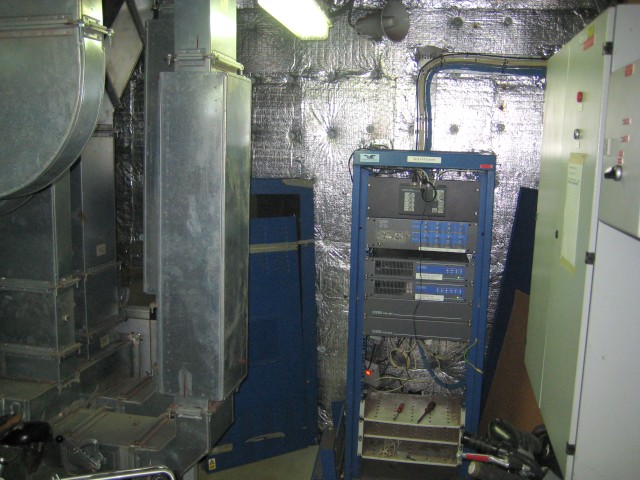
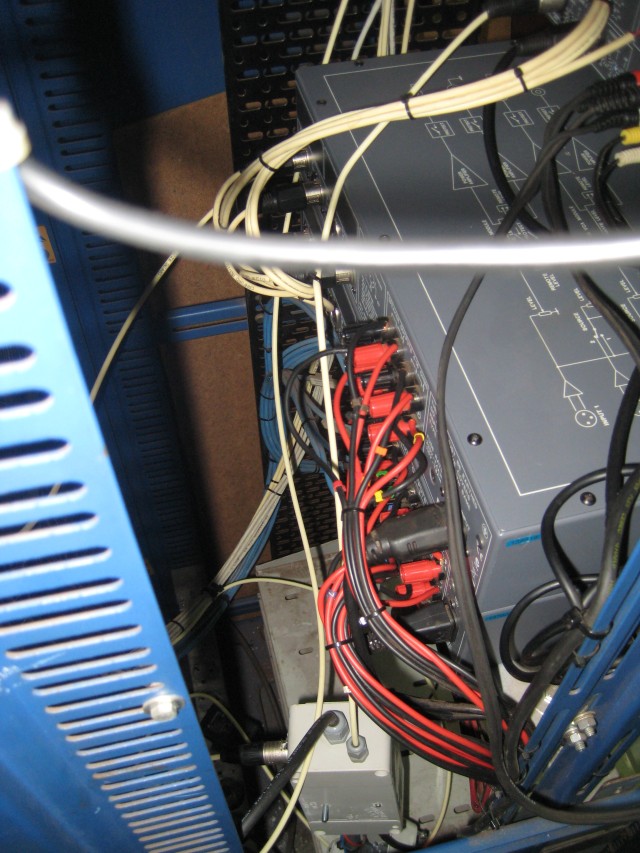
It’s not massively well documented (another task on my list…), and I think several people had tried to fix it recently, so all the settings were messed up. In the end, I pulled out the entire system, took it down to our storeroom to clean and test and set up, and then brought it back and plugged it in. It all worked! Which was great. It just then took ages of walking around with the team getting them to tell me which zones were connected and had the right volumes, and so on. Not fun, and as it needs to be working before we arrive in the next port, it meant I had to do that for 4 days rather than work on any of our venues. Grrr…
The new portable ‘fender’ sound systems that we bought are a huge success. They work really well. I asked one of the new A/V team to paint ‘Logos Hope A/V’ on the side of them all so that they don’t get lost, or apprehended into some other department. I was expecting something ugly but functional. Instead I got this:

Really cool!
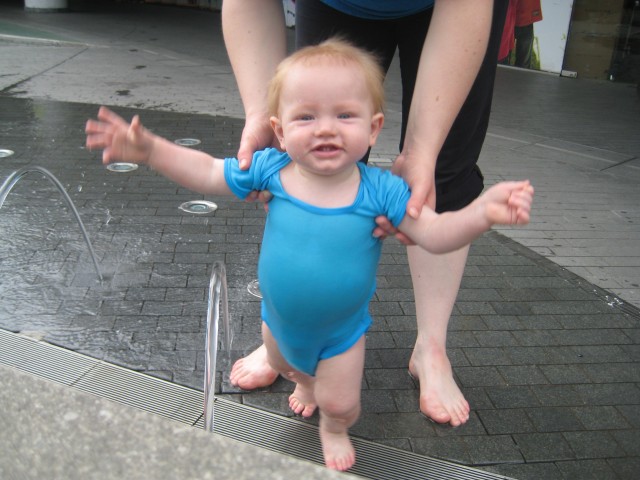
Anyway, to end this post, here’s a photo of David from when we took him to the kids water zone at the mall in Singapore. Wet as a fish, a nappy as wet as he, and as Becky puts it, “Happy as Larry”. (Whoever Larry is…)
Recently I had the opportunity to do a workshop / seminar with the Logos Hope Events team about Theatre & Storytelling. I love theatre, and am very passionate about making (especially Childrens’) events into engaging stories, rather than just variety shows with a 5 minute message tacked on the end.
This is kind of a summary of what I covered, with some of the slides I made. There’s quite a lot of content, so I’m splitting it up into 3 posts.

To start off, we looked at 3 of David’s books, which I brought along.
Mealtime is basically just a list of items you might find at mealtimes:
Spoon and Fork,
Brocolli,
Sippy cup,
Strawberry...
and so on. Not staggeringly inspiring. Often, however, events are organised in a similar manner. Get a list of things we want to put in (Introduction video, Korean fan dance, Refreshments, Sermon, Singing), have an MC or host link them all together (“Wow, that was amazing. Next we have…”) and suddenly you’ve got a programme.
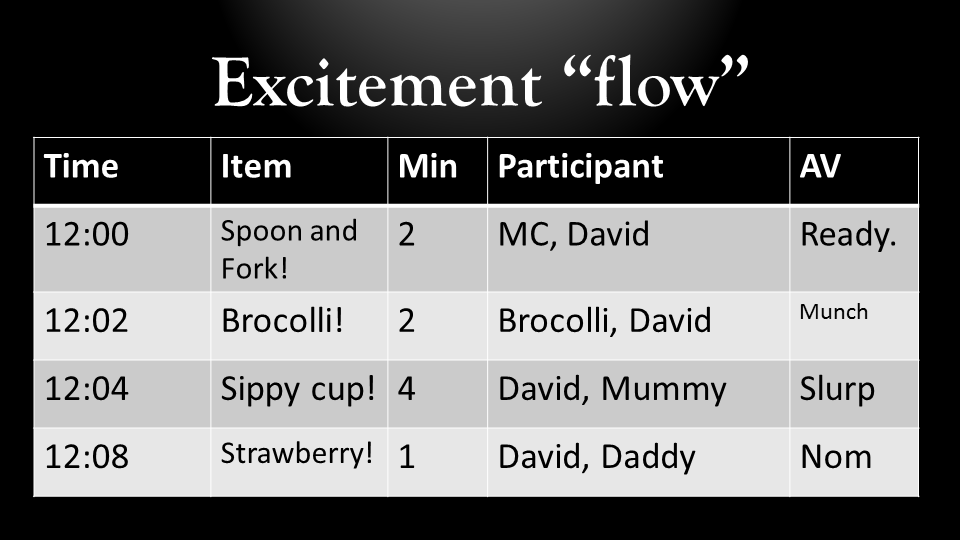
In terms of energy levels of the audience, it looks something like this: 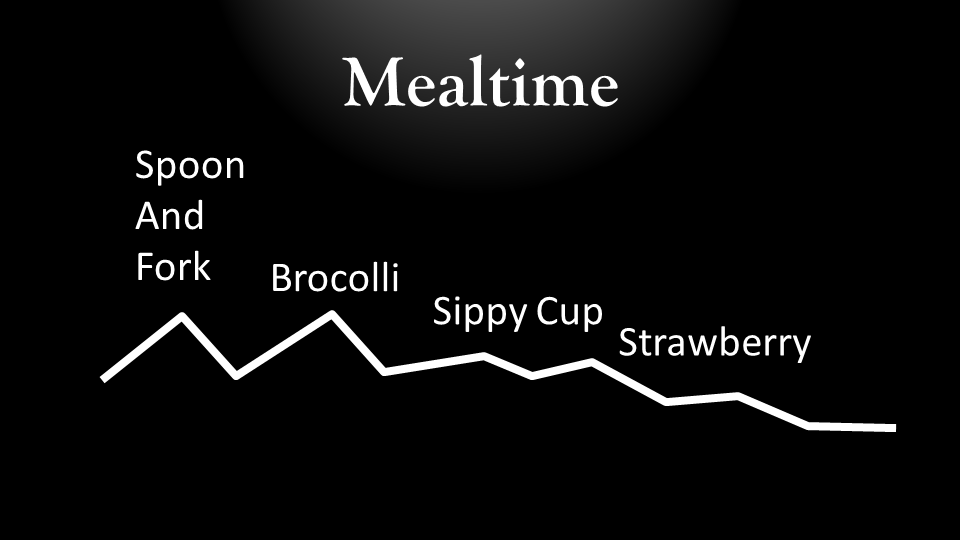
Peekaboo Forest is quite a bit better. Each page asks a question:
‘Who is hiding behind the spruce?’
there’s then a nice crinkly page to turn over:
Peek-a-boo! It’s the Moose!
So each page has quite a nice “energy” flow:

with good anticipation, etc. But in terms of overall story-arc, it’s very dull.
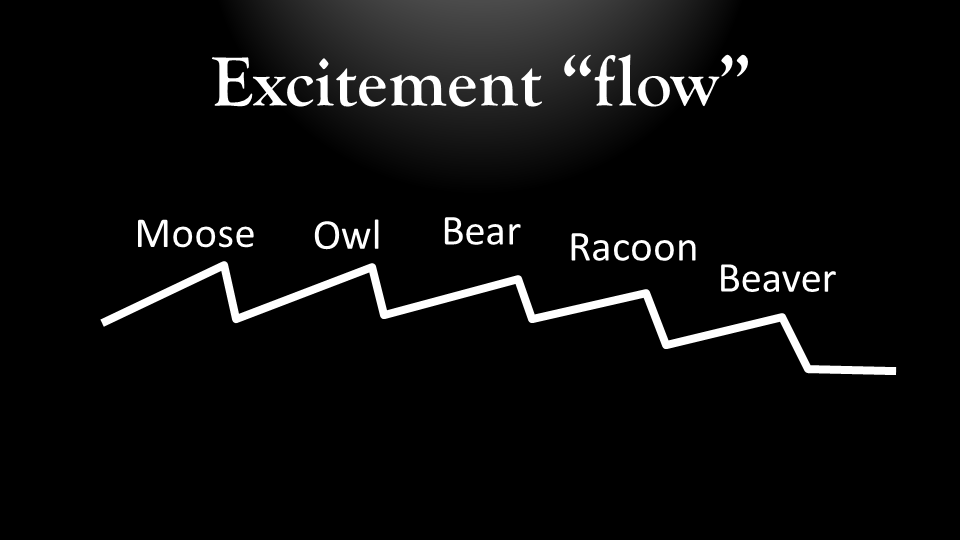
It really doesn’t go anywhere, and often programmes are like that too. Each individual item may be great, but you don’t lead the audience anywhere, and don’t have everything tied together.
Good Night, Little Bear is much more interesting. We read this to David almost every night, and even though it doesn’t have crinkly pages, he still seems to really enjoy it. The story is (essentially) little bear not wanting to go to bed, instead he goes off to play, until eventually he watches the sunset, it gets dark, and he realises he should have listened to Mama bear, and in fact he’s lost now and can’t find his way home. But then Mama bear, assisted by Little Bear’s friends, Mouse and Squirrel, come to find Little Bear. He hears them calling him, and runs to Mama Bear’s arms. He’s now feeling tired, and goes to bed. It’s really well told, with lovely pictures, and so on.
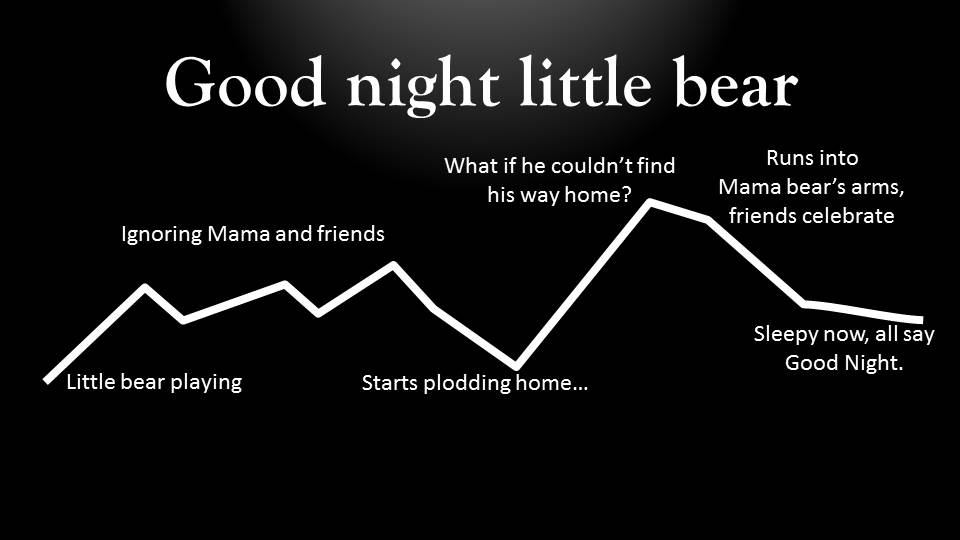
A much more complex rough energy flow chart.
So that’s the “energy flow” concept. Reasonably simple to grasp. If we are making an event which is a variety show / sandwhich programme, or a concert, then it’s worth thinking about this stuff, and saying “How do we want to start? Something big and fun to grab the attention, and then we can settle down a bit, work our way up to a climax, and then slowly bring it to a close…”.
Thinking about the age-group as well is very important. How long are attention spans, what is important or exciting? If there is going to be a verbal message / talk, then at what point will the audience be willing to sit and listen?
If we want to make the event into a story, then we’ll need to go a bit deeper.
For that, we’ll have to wait until Part 2…
Since we’re only on the ship for a few more days (!), I thought I’d post a few photos.
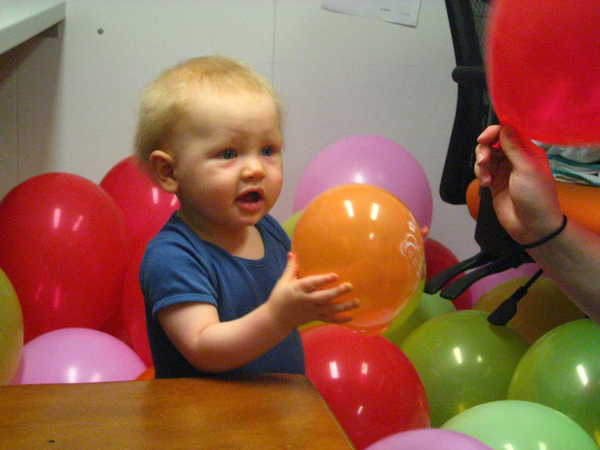
It was a friend’s birthday, and so various people filled his office with balloons. David already loves coming to visit him (Tommy), and this visit was even more fun.
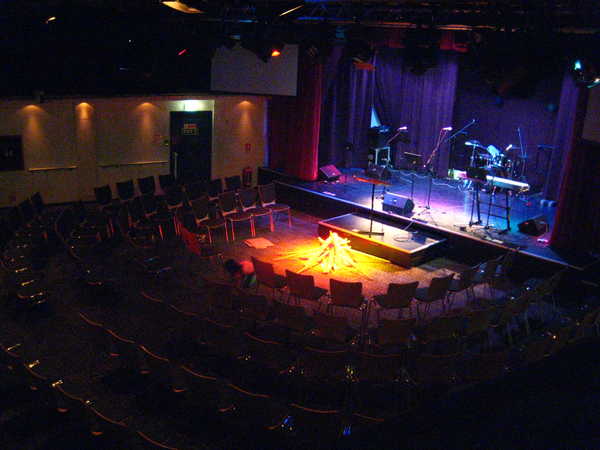
Prayer night on board. They’d decided for a “gather around the fire” kind of set up, the evening being led by the Africans on board, so I added a few lighting touches to make it feel even more campfireish.
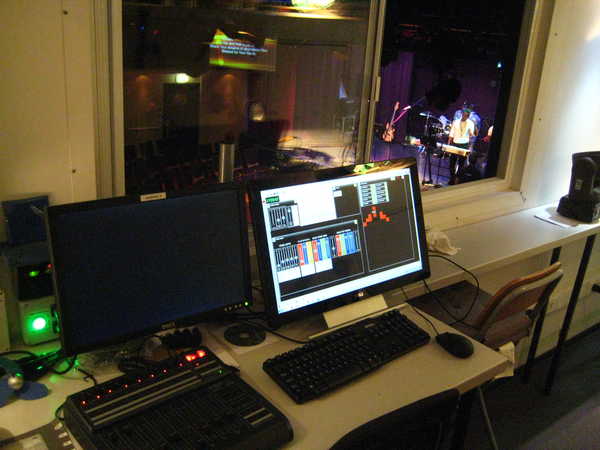
This is the new lighting control system. We’ve got rid of the old, difficult-to-teach, increasingly flaky Zero88 LeapFrog Desk, and put in place a computer, with a USB->DMX interface. The software we’re using is free, called “QLC+". It’s got a few bugs, but is *incredibly* much more easy to teach people, and allows us to do cool things like play music from the software, with lighting cues at specific times in the music, make the moving-head lights bounce around in time, etc. Cool cool stuff.
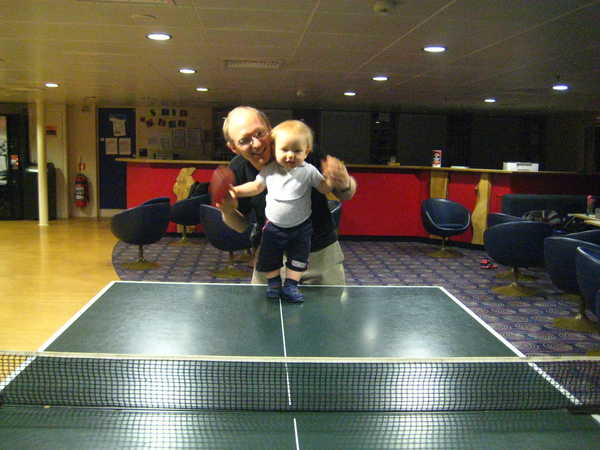
David enjoys playing table tennis with us. 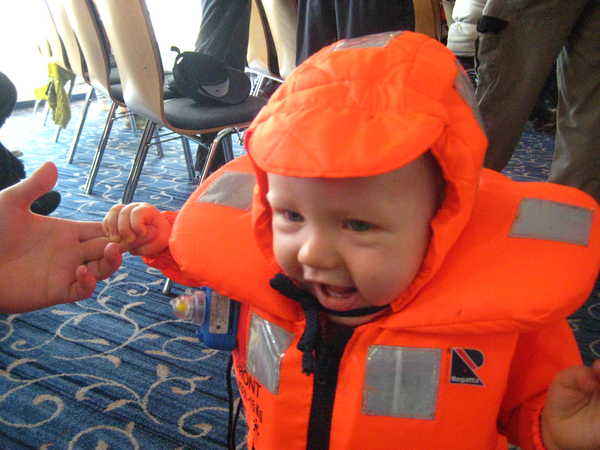
Muster drill today, David got all dressed up in his lifejacket, and looked stunningly cute, in a marine kind of way. He had fun, anyway.
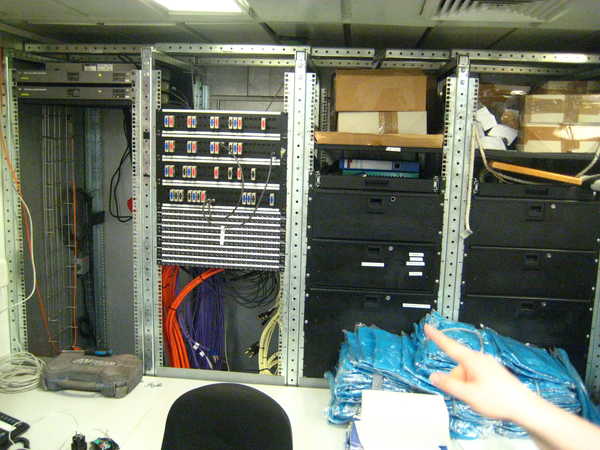
This is a project I’ve wanted to do for a while. The equipment in this office is “AVC” (Audio-Visual Central), and the main hub for all the AV routing around the ship (sending video & audio to the dining room so people can listen to devotions while finishing breakfast, for instance. Or displaying big programs in the theatre in the Logos Lounge as well as an over-flow venue, or as a place for ship’s company to watch, etc. etc.).
Anyway, This whole wall of racking is quite a mess. This office used to be the IT office, and backs on to the server room. Things have changed now, and it’s the on-shore-events team who work here, so having 19 inch racking makes no sense. And they need more storage space, and the IT folks need more storage space too.
So I suggested (about 2 months ago) moving the AV equipment into the far left rack, and then turning the other 3 racks into cupboards facing both ways, with plenty of space for the IT guys in the server room, and plenty for the on-shore teams in this office. Nothing came of my suggestion, so I thought, “oh well, the carpenters are too busy. whatever”. But now they’ve got a couple of enthusiastic project workers on the job, and everyone’s quite excited about how much more space they’re going to get.

It seems really odd that we’re going to be leaving in less than a week. Hard (in some ways) to think we’ve been here 3 months. In some ways it seems like a lot more, and in some ways it feels like we’ve barely arrived.
This is the second part of a 3 part series, transcribing / “article-ifying” a training seminar I ran with the on-board events team on the Logos Hope. Here’s a link to the first part.
Waaay back in 350 or so BC, a clever Greek dude (Aristotle) said that he reckoned a good story (or theatrical performance) had 3 parts to it:
Yep. It’s what you’re taught in primary school creative writing. Expanding those a bit:
In some ways, the most important thing from this is that without a problem, there is no story. There has to be “something rotten in the state of Denmark”. Or else what keeps your audience more interested in the programme, than in what’s on their phones?
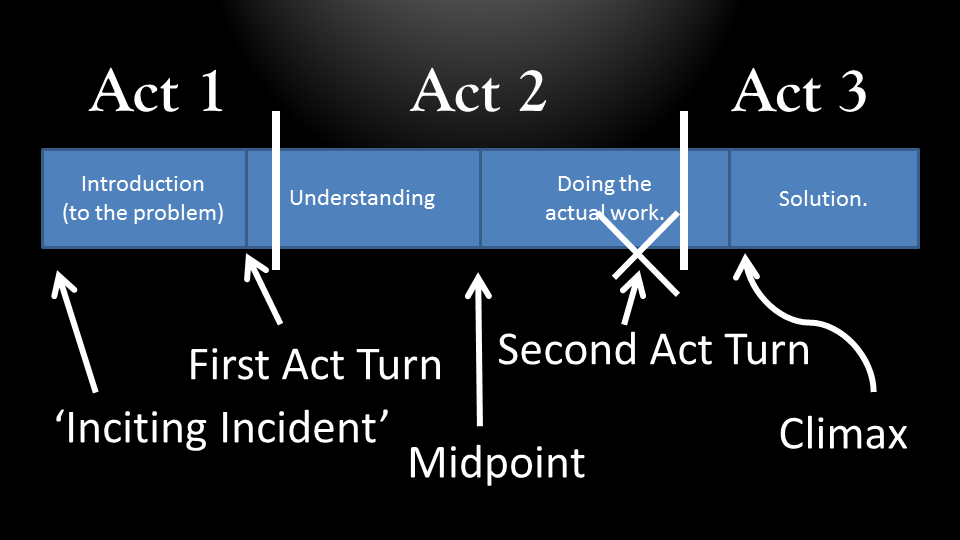
Taking this concept a bit further, is the traditional “3 act play”. Often our events aren’t done in acts, but the concepts are useful for thinking, “Where should I put the refreshment breaks?” and thinking how the story energy levels should map out best. Whether or not you actually use this model, it’s still an interesting one to look at, and see if it helps you.
The 3 acts are pretty close to the “beginning, middle, end” concepts from before, but expanded.
Confusingly, sometime the 3-act-play can be broken down in to 4 parts:
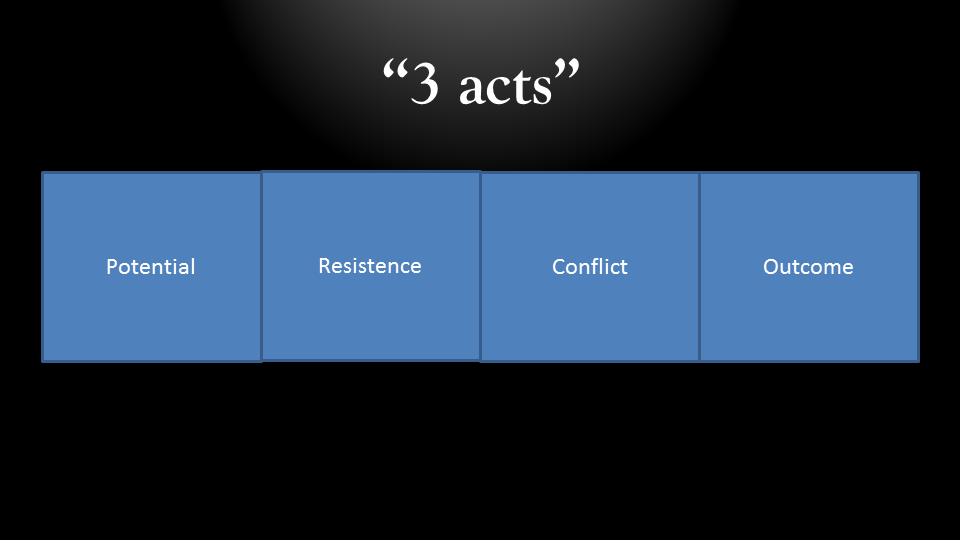
which progresses through the main character (and audiences’) perception of ‘The Problem’.
There’s “potential” for an interesting story - you set up the main character(s), and the problem. But they’re not actually in conflict yet (at least, as far as this specific narrative goes.) There’s resistance to the conflict - things get in the way, the problem isn’t fully understood yet, etc. Finally the conflict itself, actually doing something, rather than just trying to understand the problem, and finally the outcome, and cleaning up.
I mentioned that the Main Character and the Problem may not be in actual conflict yet. Just to note here, this is for the purposes of this narrative. For instance, in David and Goliath, Israel and Phillistia are at war at the beginning of the story. However, the Main Character, David, isn’t actually in personal conflict with Goliath, until much later.
So how do these 4 parts map onto a “3 act play”? 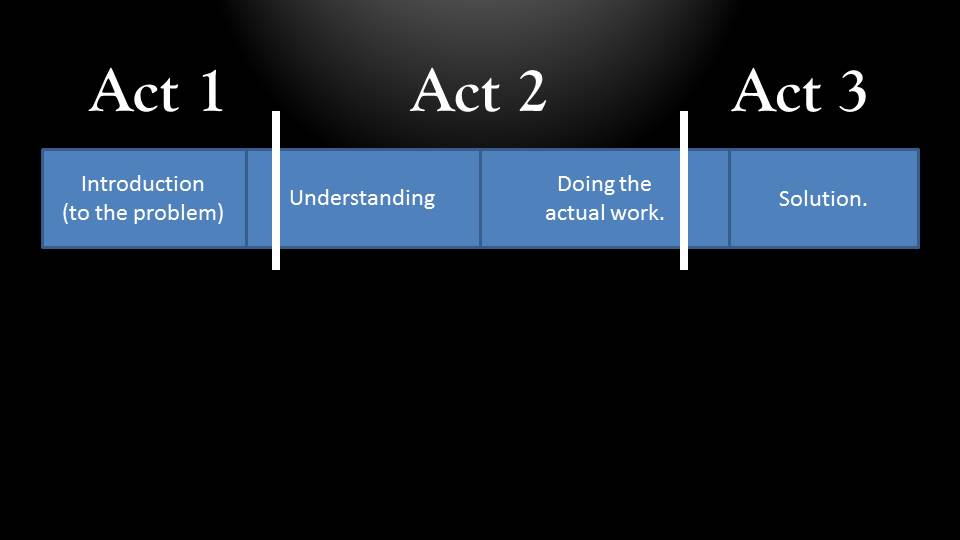
Starting off the play, you need some kind of event which introduces the reason for the story.
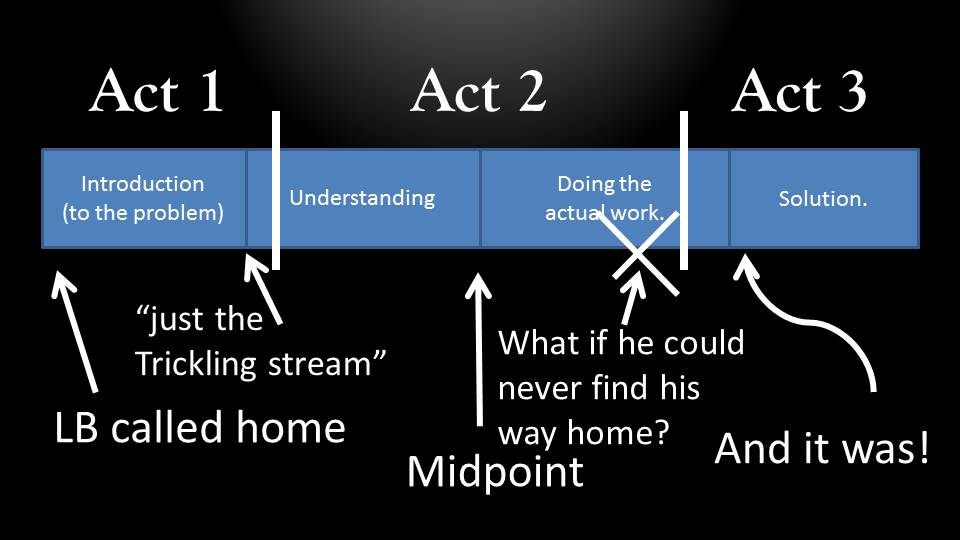
The children of Israel are at war with the Philistines. Jeff Winger starts at his new Community College; Darth Vader boards Princess Leia’s diplomatic space ship and takes her prisoner; The orb of Aldur is stolen; Little Bear is playing, and it’s getting late. 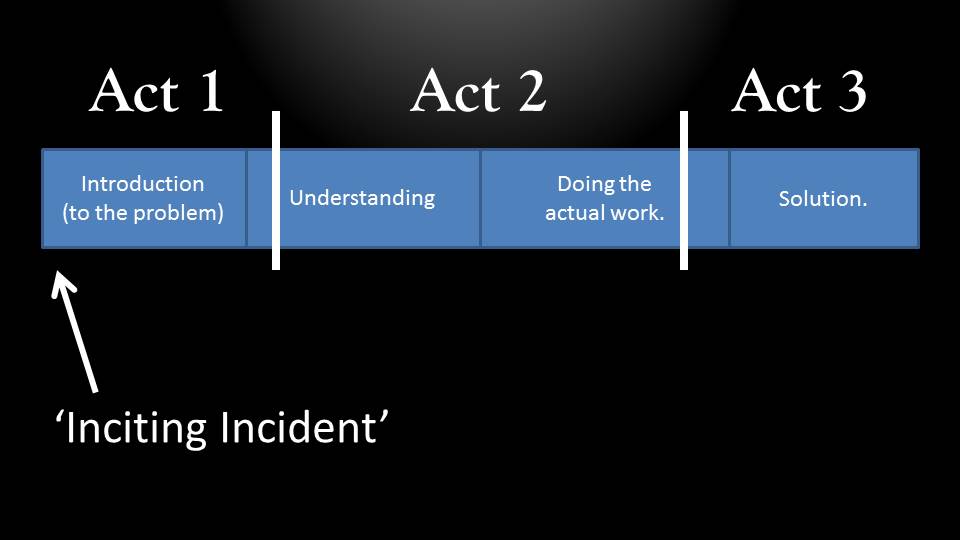
One thing to note is that this might not involve the main character. It’s setting the scene for the whole rest of the story, and may in fact be the cause for many different stories to happen. A murder has happened, but at least so far, the main character may not yet have been put on the case.
As “The Problem” now develops, at some point it’s going to bump into the main character, and eventually, somehow, they’re going to have to do something about it. They may not be keen on the idea, they may need to be persuaded, or dragged kicking and screaming into it, and often it’s more fun if that’s the case.
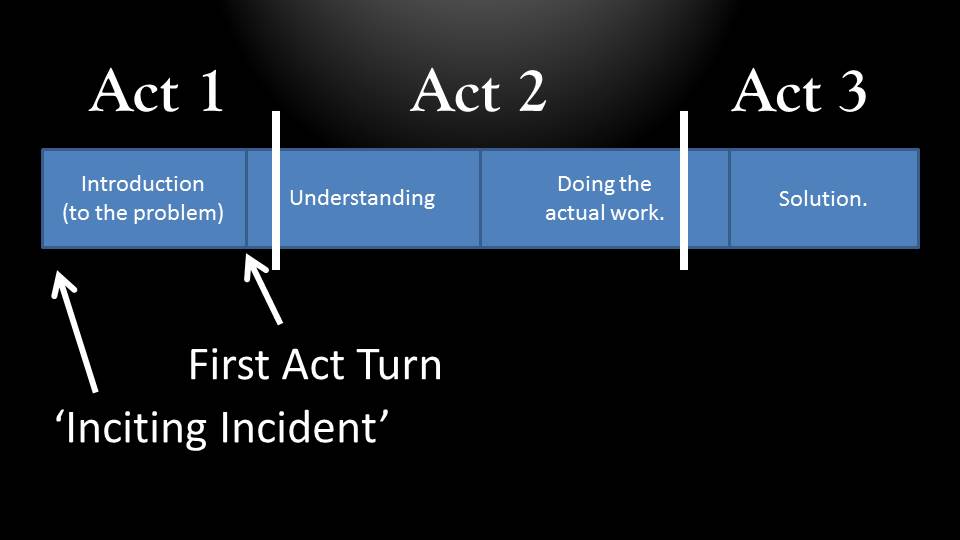
Now you’ve actually got the audience hooked to the story - they’re interested in the character, and now the character is about to go do something interesting. This is a good ending point for the first act, so you might as well try and sell some refreshments, as you know the audience will come back to find out what will happen.
Curtain up again, time for Act 2. It’s been joked about that you should just skip Acts I and III and just go with II, as that’s where all the interesting stuff happens.
In the four stages listed above, you can see act 2 divided in half. The first half is typically about understanding the problem, the second half about actually going to do it.
So first, we learn more about the problem. Often there’s a lot of discovery, trying to understand the problem first, and then later transition into actually doing something about it. David starts asking his brothers about Goliath, and they despise him. The Prodigal Son is burning his inheritance, not realising the consequences.
Sometimes, around about the mid-point, there’s a good point to stop, pause, and say, “Right. Now we know what we need to do, lets do it!”
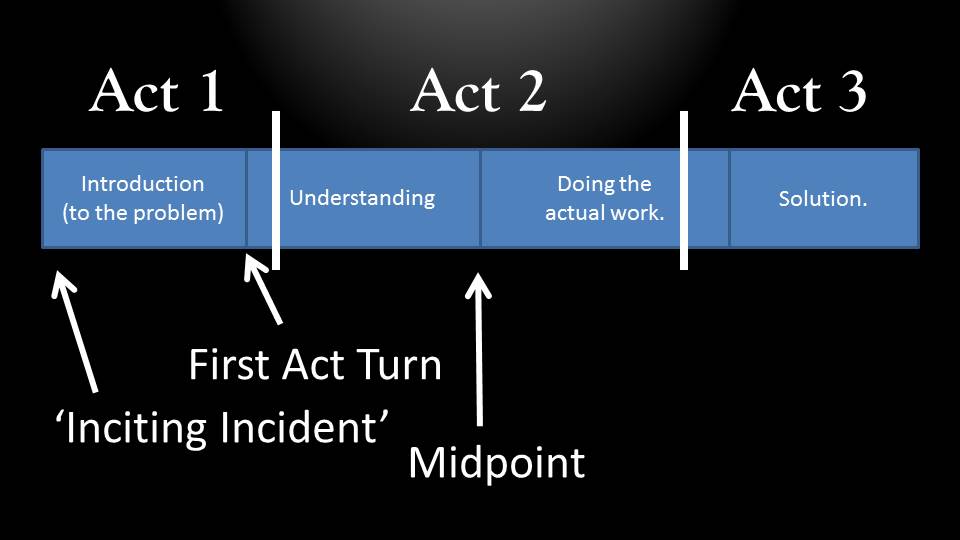
The mid-point can be the major turning point in the story. David’s questioning about Goliath finally reaches the ears of King Saul, and he calls David before him. The Prodigal son’s money finally starts to run out.
Now we’ve finally got to a place where the Main Character will come into actual conflict with the problem. David tells the King that he’ll go fight Goliath.
However, often the “doing” is more complex than originally thought, and it can all go terribly wrong.
The King tries to give David his armour, but it’s far to big, and David falls on his face. The Prodigal Son thinks he can still be self-sufficient, but his “friends” reject him, and goes on the hunt for jobs. Eventually he finds he has no skills at all, and ends up feeding pigs.
Obi-wan dies fighting Darth Vader; Garion decides to leave his friends, his Aunt, his safety, and go to fight Torak himself; Little bear realises it’s dark and he’s all alone, and he doesn’t know the way back home.
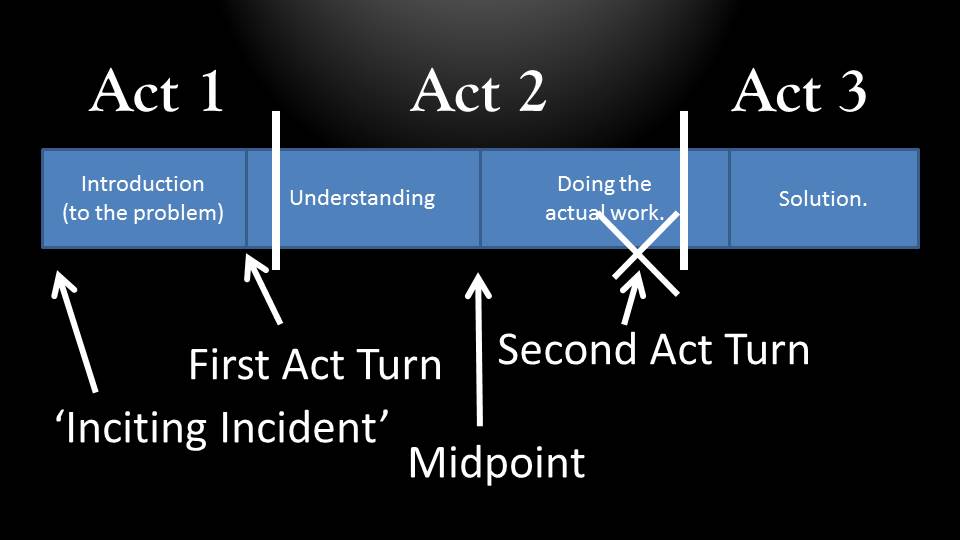
This sudden swing - it looks like the hero will be defeated, or the current route is blocked is a really good way to bring the audience up short. Things might have been challenging before, but at least it was going somewhere. Now what’s going to happen? This is the “Second Act Turn”. Again, roll out the popcorn and drinks; art doesn’t pay for itself, you know.
The third act needs only 2 main features:
OK, you may not always want the audience to feel good at the end. Sometimes a tragedy is more moving, and you know what, frequently life sucks. But you want them to feel satisfied that they got their money’s worth, and that it’s probably worth coming again.
There are other subtleties you can add to this basic overview, such as adding “The Question” as a (sometimes hidden) subtopic to The Problem. The Question can be something more personal, or more meaningful than just solving The Problem, and it’s only through The Problem that the main character can understand The Question.
So, that’s the “3 act” model of telling a story (at least, a version of it). In some ways, quite complex, but it explains pretty well how the energy-concepts from Part 1 can map onto a longer story.
As a bonus, here’s Good Night Little Bear:
So this is Part 3 of my seminar / workshop on Story Telling that I did with the Logos Hope On-Board events Team. Here’s Part 1, and Part 2.
There’s an interesting alternative theory called, “The Hero’s Journey” (or “Monomyth”). There’s books written about this, some really cool ideas. A very approachable version is by Dan Harmon, the creator of Community. Ant Webb was the guy who introduced me to both Community, and the Hero’s Journey. We’ve been discussing it and used it as part of Matt’s Blog.

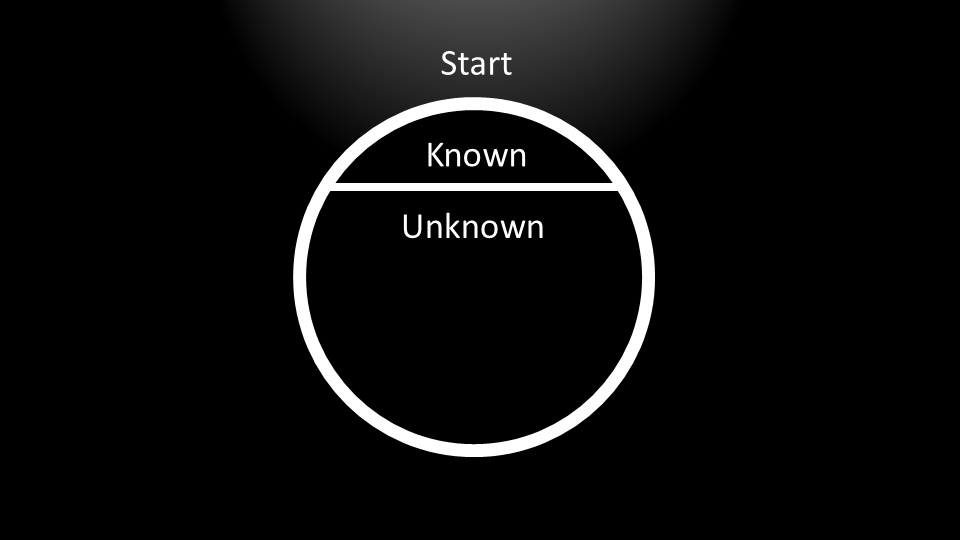
The full theory has all kinds of Freudian stuff to do with being forced out of the mothers arms by the call of the father, eventually defeating the father, and returning eventually as a mother or father all that… (Seriously, Freud had issues.) Also, there’s loads of details that are reasonably important, and do make the story more compelling, but also, with much added complexity. 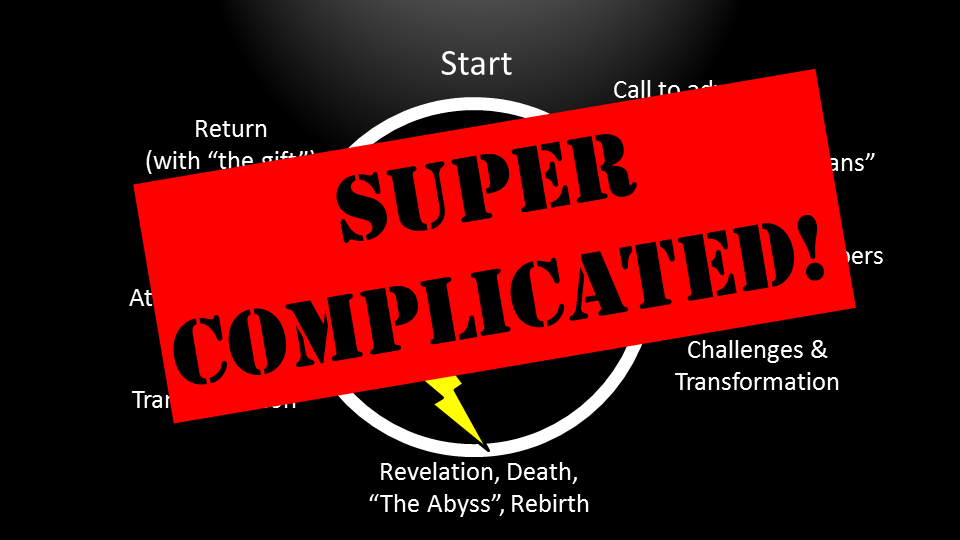
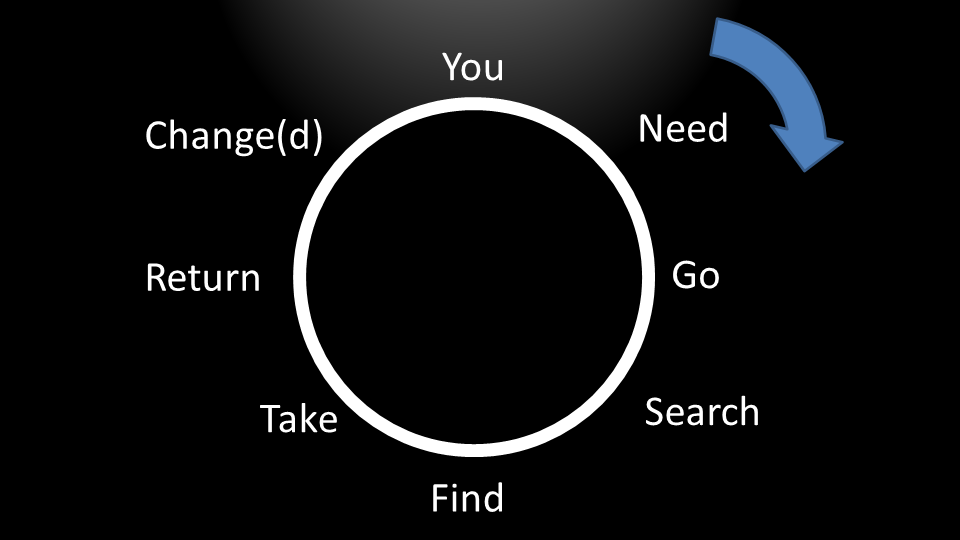
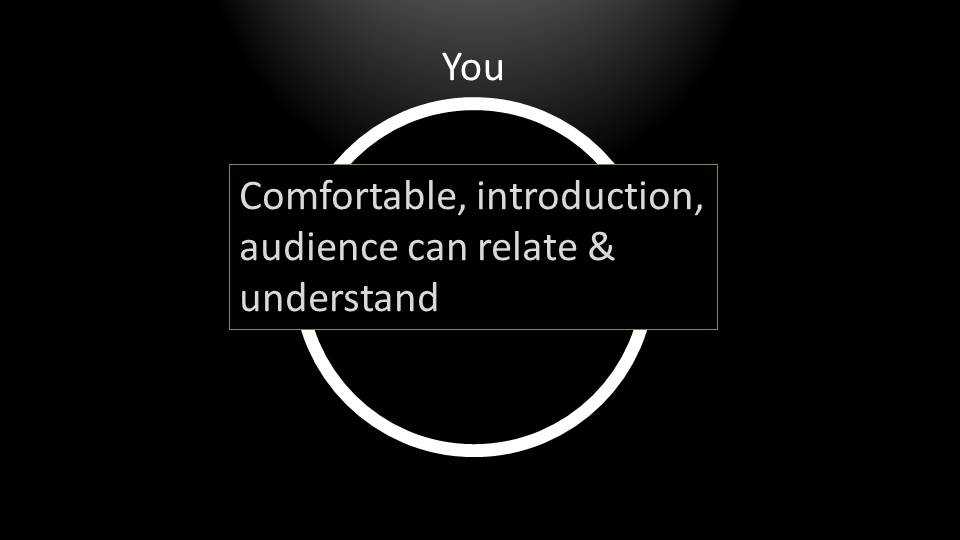

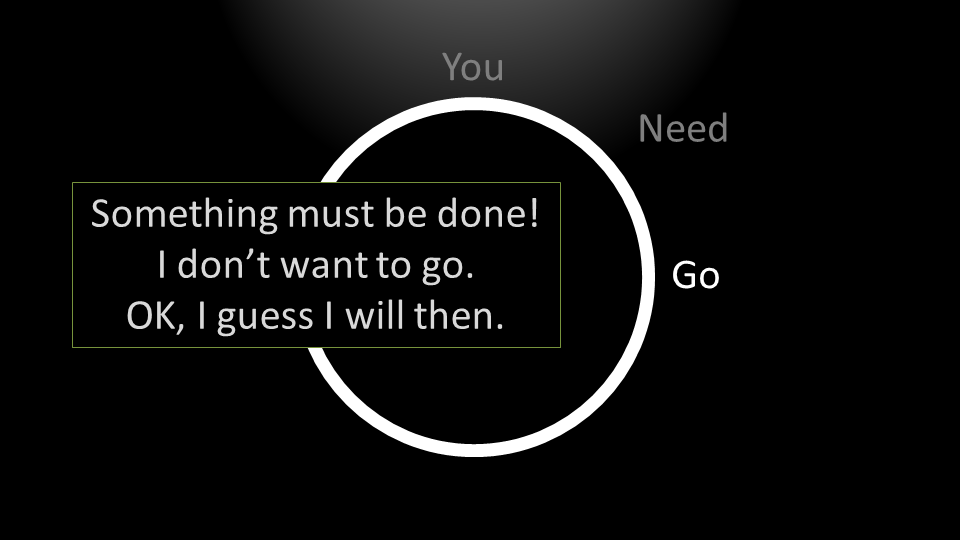
So, since there’s a need, I guess we’d better " Go" do something about it. This is where the Hero decides to actually leave their safe familiar environment, and go out into the world to solve the problem. We finally dep 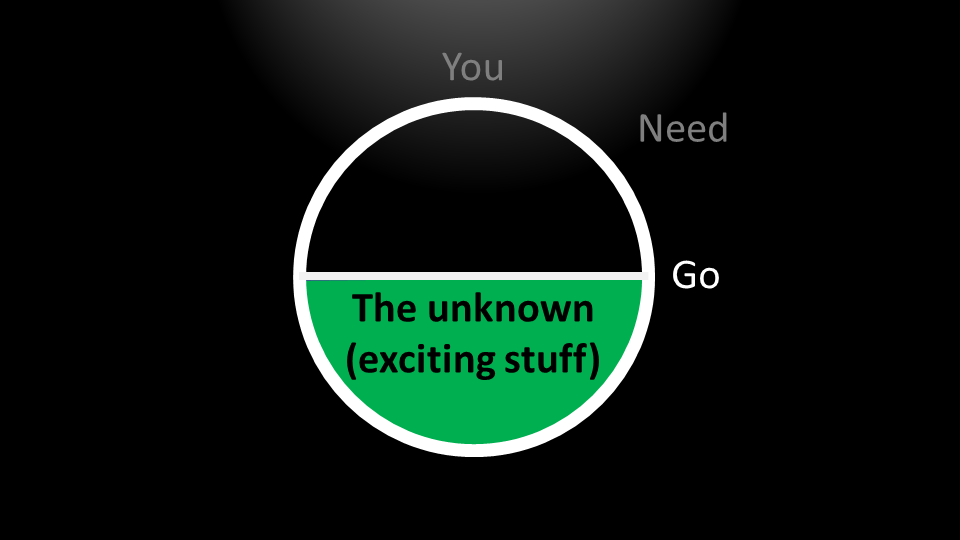
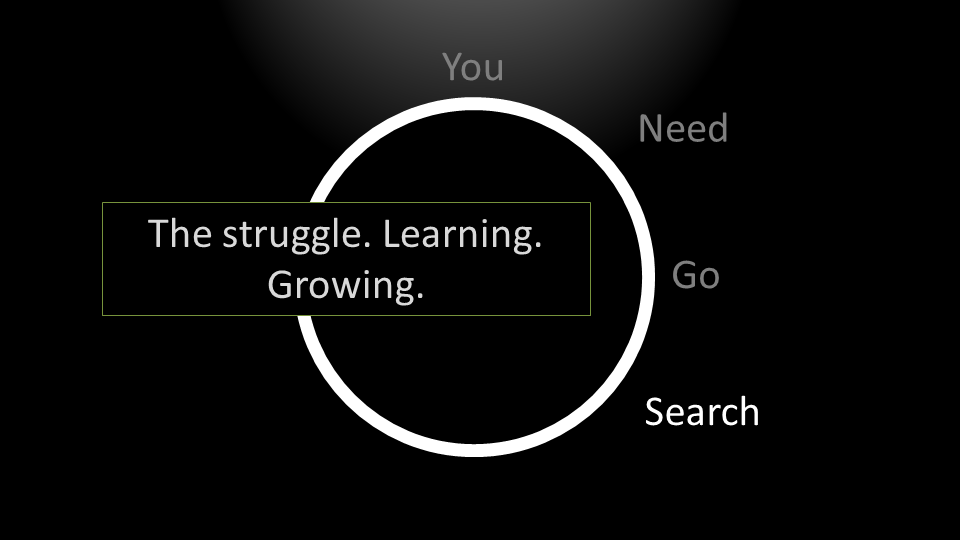
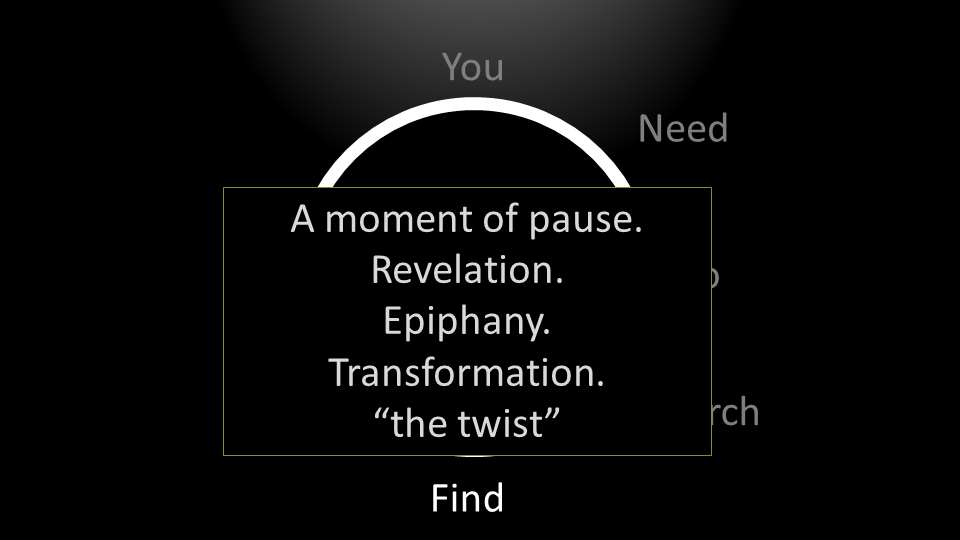

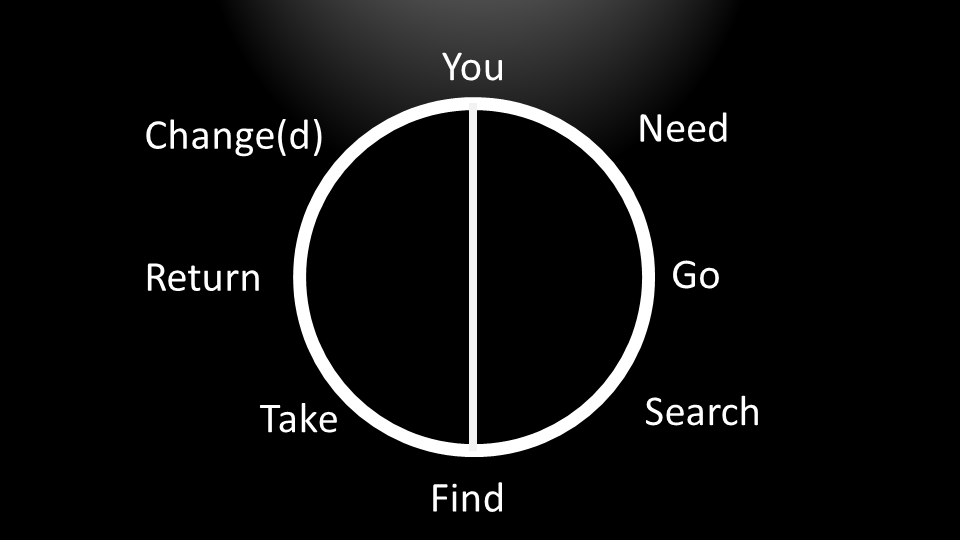
Let’s move on:
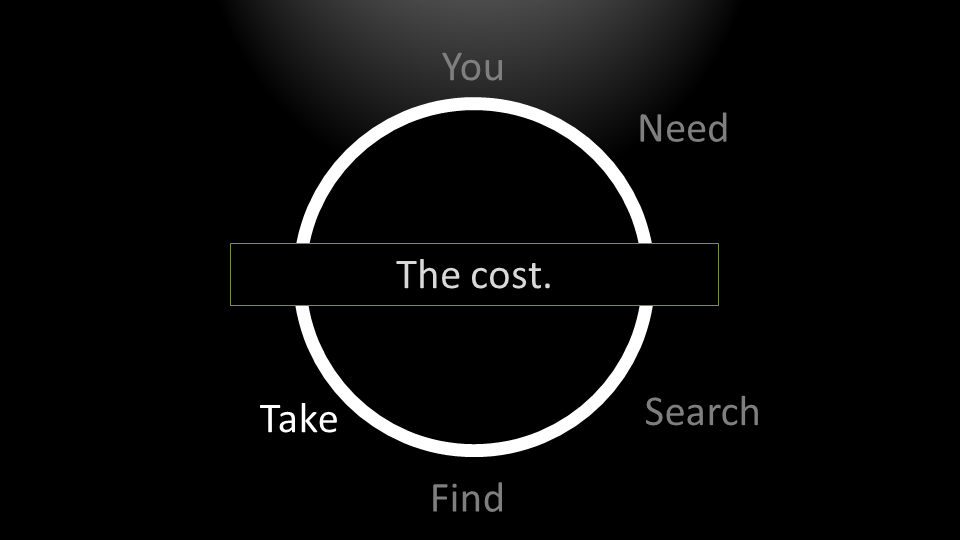
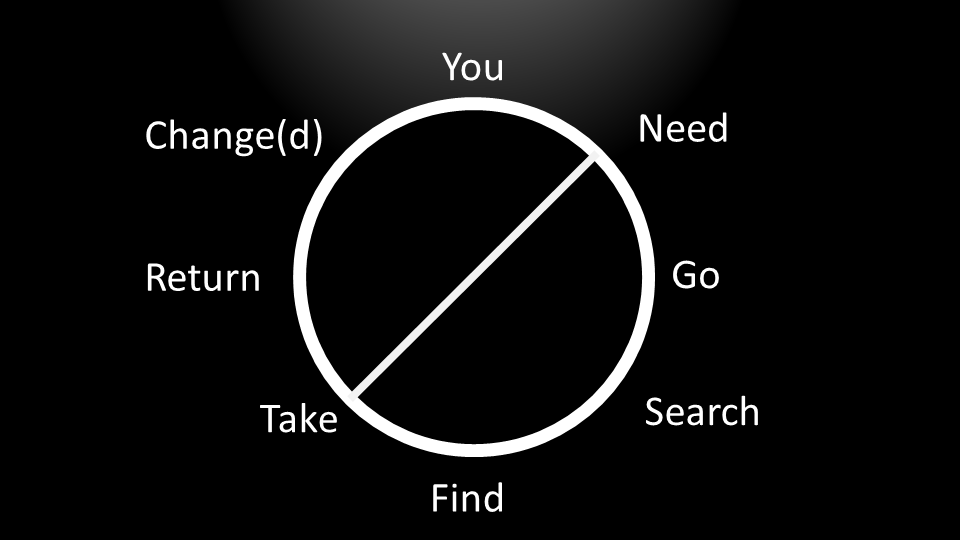
Note: Often the Find and Take are very close together, the 8 points on the circle don’t need to each have equal screen-time.
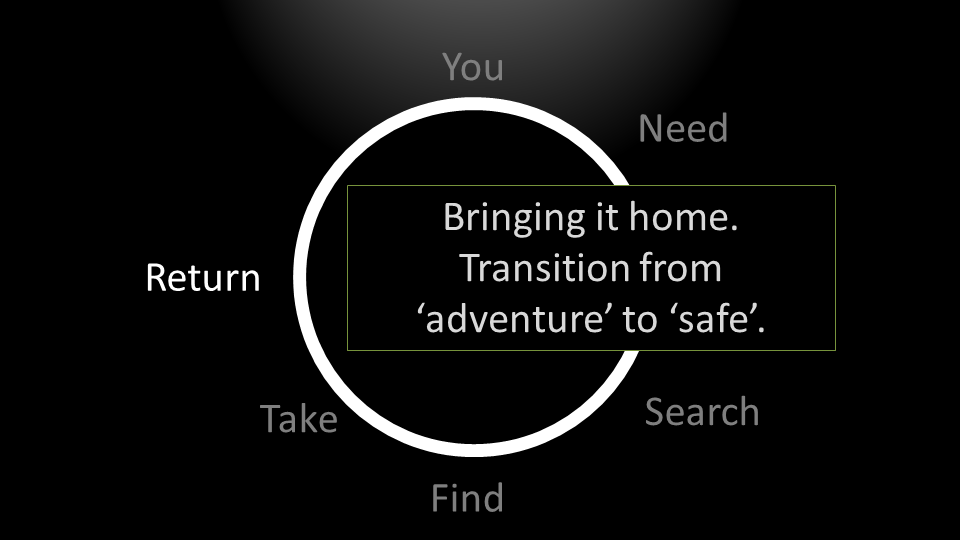
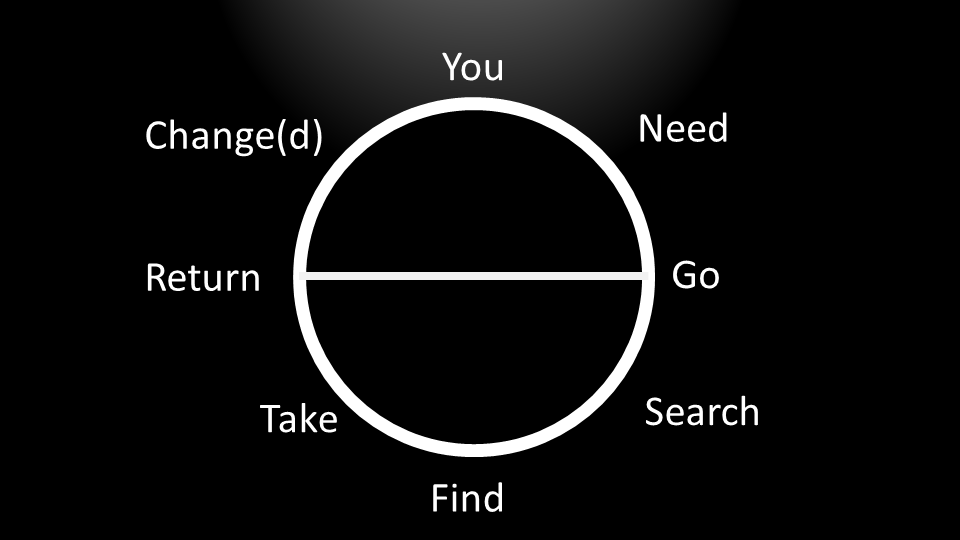
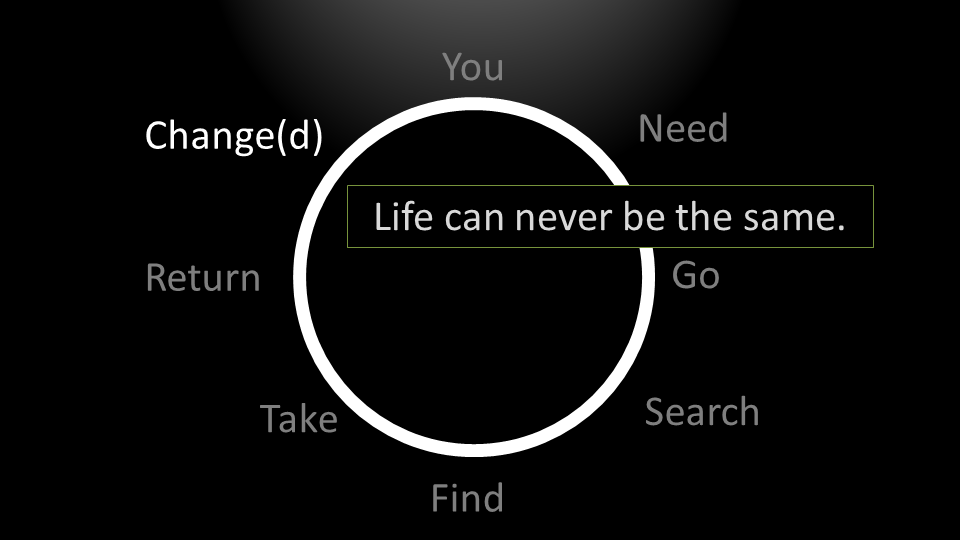
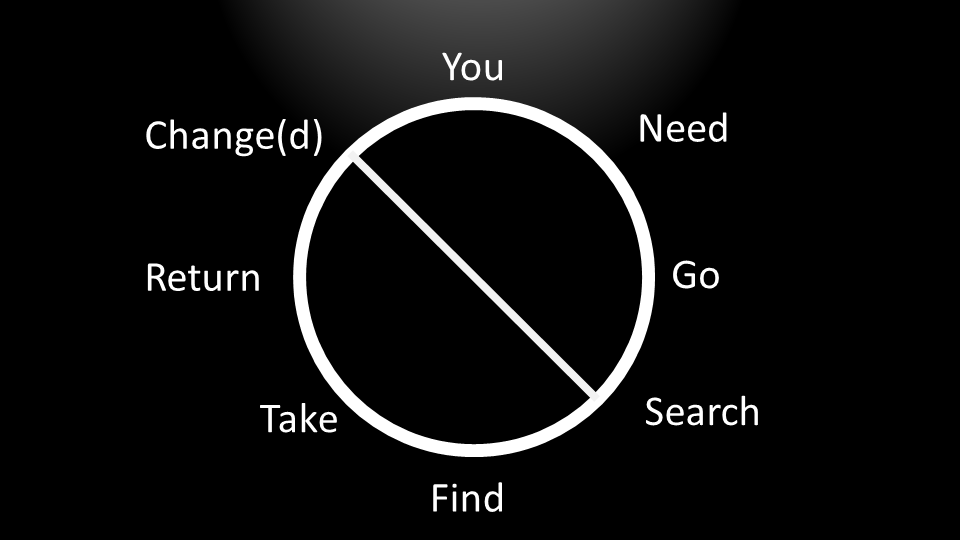
Let’s look at our example, Little Bear, again…
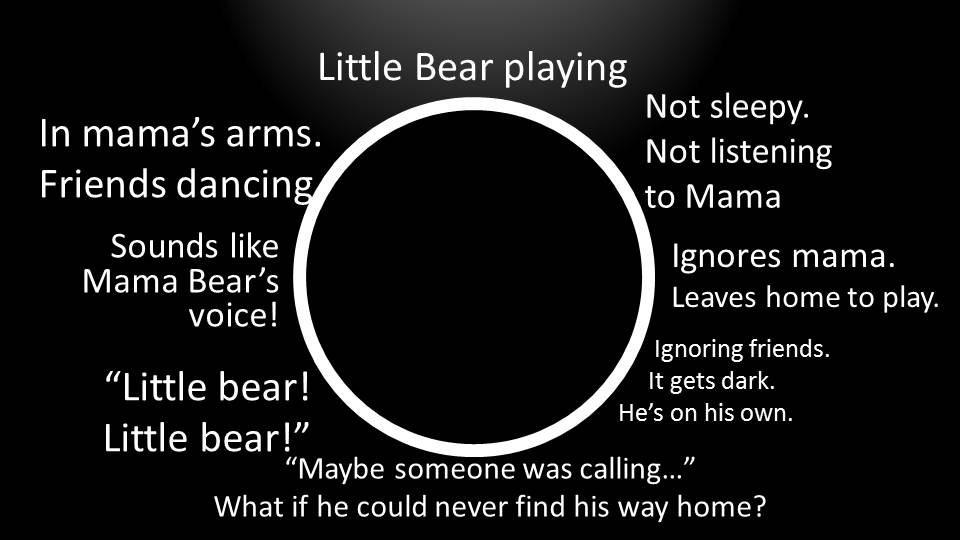
Pretty cool, innit?
And that concludes my mini-series from the workshop. In some ways, I wish I could have just told the Events Team “Go Read Dan Harmon’s Blog Posts, and watch Glove and Boots!”, but the ship’s firewall blocks half of it for profanity, and it would shock the heck out of the team for actually containing said profanity, and doing a workshop is actually a lot more meaningful to many people than simply reading it on a blog. But since you, dear reader, have read my blog, here’s a link to the stuff Dan Harmon wrote about it. It’s also in several parts. And probably quite a lot clearer than what I wrote. My audience was a bit different, and I was simplifying in different ways because of the direction I’m trying to influence them. Read what he wrote. There’s good stuff there.
Glove and Boots also did a video about The Hero’s Journey, which covers the more character-centred side of the theory:
Anyway, I should stop waffling now. I’m writing a lot of this while sitting on a cold floor in Changi Airport in Singapore with my wife and 1-year-old son sleeping next to me at 5:30am. I think I’ll wait until I get home to proof read it once more before publishing…
For my current blender project (‘The Night Show’) I needed to create a neon sign. It took a while for me to figure out how to create reasonable looking neon in cycles that didn’t take years to render cleanly. This is the method that I came up with.
I had the enormous privilage to speak at the Blender Conference in Amsterdam!
I was talking about the latest large project I’ve been working on together with a team from Ireland, building a full virtual 3D set for a “late night” comedy show for puppets, going through the christmas message.
It was great fun, a lot of work, and a really cool project to be part of.
Some of the 3D stuff was pretty complex to work on, and so it was interesting to show off some of how we were doing the compositing and working with the puppets and greenscreens & everything.
I’ve been doing a bunch of media production recently, Some work as cameraman, some as producer, some as editor.
Here’s a few links!
I was the director and producer of this and a couple other pieces. Myself and two cameramen travelled in 3 cities in Albania, meeting the OM team there, interviewing them, and finding out a lot of what they’re up to.
Currently still unreleased, “almost done”, I was the 3D set design and animator, did all the 3D compositing, and helped with a lot of the 2D compositing and editing. I also did the sound recording and initial scratch mix for the puppeteers.
I worked as senior editor on this project, helping Moray to bring together many different interviews into a single history presentation.
Dear Neglected Blog -
I think I should start writing again. I’ve realised how much I miss it.
I don’t know how often I’ll manage it - but we’ll see.
Brief update for the sake of historical thingness (as Euan might say):
We’re back on the Logos Hope - 4 of us now. This time for probably 2 years. We’ve been on board almost a year now, and are currently on break (thus finding the time for writing, and motivation to start again).
Life on the ship is spectacularly busy with 2 children. Essentially any time that’s not work, while the kids are awake I try to spend with them. And when they’re asleep, then with my wife. But I’m realising I do need more introvert / me time to help make the time with kids+wife better quality.
Blogging kind of takes a back-seat - as I feel like the writing I want to be doing is all fiction, and the writing I should be doing is all email / work related.
Anyway, hopefully writing here helps me feel more inspired to write other stuff that I need to. And also is perhaps interesting for you, dear reader.
This year the Creative Writing Passion-Group on board were asked to make a series of brief reinterpretations of the Advent story for every day at lunch-time on board.
Here’s my two contributions:
Phone Rings You have reached the extension of Meshack, Permanent Secretary for the office of Internal Affairs, Babylon. I’m afraid I’m unable to take your call, but if you leave a message and contact information, one of my scheduling staff will return your call. BEEP
Daniel: Mishack, this is Belteshazzar, if you could contact me please that would be great. I’ve had a bit of an odd, er, experience I’d like to talk about with you. Shalom, Click
Phone Rings You have reached the extension of Meshack, Permanent Secretary for the office of Internal Affairs, Babylon. I’m afraid I’m unable to take your call, but if you leave a message and contact information, one of my scheduling staff will return your call. BEEP
Daniel: Oh for goodness sake Mishael - answer your blasted phone! It’s me again, Daniel. Look, the dreams have been getting stranger. I swear I’ve not touched a drop of the King’s wine. So there were these beasts, coming out of the sea, all mixed up - a leopard with four wings, a lion, a bear, hideous. This wasn’t some stupid nightmare. Nightmares are way more mundane.
I can remember so vividly, like I was actually there - I’m not going to tell you every detail now… it all ended, somehow with me seeing into the thoneroom in heaven itself! And there, a “son of man”, like, how you described the fourth man in the furnace? The same! And he shows up in the throneroom, and was greeted royally, and then gets made ruler of the whole planet! An eternal kingdom, full of every kind of people, diverse and spectacular, immense and unlike anything we’ve ever seen, Mishael.
So I went and asked one of the court guards what on earth was going on - and he told me it’s all about the future, the beasts are kings who are coming, and eventually the Most High will judge the last kingdom, destroy it, and hand it all over to an eternal kingdom of His people.
Look - I honestly don’t know what it all means, brother. Or why on earth I had this dream. I thought these dreams from the Lord were supposed to be meaningful? How can I make SMART goals or an Action Plan from something like this?!
It’s terrifying, seeing the horrors of so far in the future - I know the Lord will send this Son of Man in the end - but it’s such a long way off - why tell me now? I wrote it all down - maybe you could come by to read through it. Perhaps someone else will find it encouraging. Call me. Click
Featuring the Prophet Daniel (played by me) and his Life Coach (played by Dan Potter).
Doorbell, Door Opens
S: Belteshazzar! It’s good to see you again…
You missed the last 3 sessions… How have you been?
I hear from Shadrack that you’ve been sealed in your rooms?
What progress did you make on your action steps?
D: I’ve prayed. I’ve fasted. I’ve repented. I’ve wept.
S: That’s great, er, none of them were things we talked about
last time - but they all sound… useful?
D: Yes. I had a vision.
S: That’s good, right? You’re the one who interprets the King’s
dreams and visions so…
D: I don’t. The Lord does. And He tells me what they mean.
S: Yes, of course. So, what did the Lord say this time?
D: It’s complicated.
S: That’s surprisingly candid, coming from Him.
D: Stop it. So I read Jeremiah’s prophercy, it’s we’re almost
finished with the 70 years until the Temple and our people
are restored - and we’re nothing like ready. That’s why I’ve
been praying and fasting and repenting - How could we
possibly be ready to return?
And while I was praying, the Lord sent an Angel, who told
me many things…
S: Like, er what?
D: Our people will return, we’ll finish rebuilding, the sacrifices
will resume - and in then a while later, the Messiah
will come.
S: That’s amazing!
D: But He’ll die - appearing to have accomplished nothing.
S: But - but - all the other prophercies say all kinds of things
he’ll do!
D: I know. I said it was complicated… and the Angel said
" appearing to have accomplished nothing." So maybe he’s
going to do things in secret? Or somehow won’t be noticed?
S: That doesn’t sound very Messiah-like.
D: I know.
S: This is fascinating, but I think we’re getting a bit distracted…
What would you like to take away from our conversation?
D: I’d like to get some clarity about sevens.
S: Sevens?
D: Yes… Apparently they’re quite important. And we’re going
to have an awful lot of them before the Messiah comes.
S: Er, right. So, what are the key points of understanding these
sevens?
D: I’m not really sure. An Angel told me about them. His name was
Gabriel. He was really nice - He told me that I’m precious to
The Lord. I have a feeling he’s involved in this all some how.
And then he started talking about all these sevens… 70 sevens,
then another 7 sevens, and then 62 more sevens after that.
S: Is there a cultural Angel to understanding this angle? Or cultural
angle to understanding the Angel, I mean.
D: Do Angels have a culture?
S: I don’t know! You’ve met more than I have!
D: True. hm. It’s a good question. A cultural angle..
Well - creation took 6 days,
plus the Sabbath - but 70 weeks is less than 2 years - it can’t
mean that… we used to have special celebrations every 7th
year - I think it’s seven years… so about 500 years,
in total, I guess?
S: So… what actions will you take to move forward?
D: 500 years is a really long time! I could do a lot of action
steps in 500 years.
I think I need to go pray some more.
S: That’s always a valuable thing to do…
What do you want to remember from today’s conversation?
D: I thought this was just all something to do with us returning
to the Jerusalem soon - but I think it’s something bigger.
The Lord isn’t just preparing us for the end to our exile -
There’s so much going to happen.
S: Hmm. So you said you wanted to get some clarity about this…
Out of 10, how clear is it now?
D: Maybe Seven?
This was written by our friend Becky Breckels and me, and then read by my amazing wife.
Door opening and shutting
Elizabeth: Zechariah! You’re home! How was the Temple? Anything exciting happen?
Pause as is if Zechariah is speaking
Elizabeth: What’s that love? I can’t hear you!
Slightly shorter pause as Zechariah gestures wildly
Elizabeth: Well I can’t understand you if you’re just going to stand there gesturing! *deep sigh* Fine, we’ll play charades.
Your eye. A drink? A can. Tying something… a knot? Oh! “I Can not”, you cannot what? Talk?
…
Elizabeth: What do you mean you can’t talk? You’ve never had any problems talking before!
Zechariah starts gesturing wings.
Elizabeth: What are you trying to say? Wings…a bird?
Zechariah shakes his head
Elizabeth: No…? Not a bird…well what else has wings?
Zechariah starts gesturing a halo
Elizabeth: What’s that supposed to be?! A circle above your head!?
Sounds like a heart? A Triangle? Half a triangle? That’s still a triangle! Second half of triangle? Ngle? Sounds like ngle?
Zechariah starts gesturing both wings and a halo
Elizabeth: …AN ANGEL! You saw an angel! Blessed be! An angel! Well…what did he say?
Zechariah starts gesturing writing
Elizabeth: He told you to write something?
Zechariah shakes his head
Elizabeth: You know this would probably be easier if you had your writing things. Now, where did I put them… (fades out)
Sounds of pots and pans clattering
Elizabeth: Ah! Here they are! Now, what did the angel tell you?
Sounds of writing on a blackboard or tablet
Elizabeth: We’re going to have a son!?
This is all a joke, right?
More writing sounds
Elizabeth: His name will be John?! But that’s not a family name!
This must be a joke. I’m going to go make dinner.
OK! Fine, I’ll wait. You’d better make the punchline worth it.
Continued writing sounds
Elizabeth: (Writing sounds throughout) …No alcohol…filled with the Holy Spirit! Spirit and power of Elijah! You’re serious? This isn’t a joke? Turn many to the Lord…prepare the people for the coming of the Lord! …For the coming of the Lord! The Messiah!? He’s coming soon then?
Zechariah shrugs his shoulders
Elizabeth: What do you mean you don’t know! … You didn’t ask!? You had an angel of the Lord standing right in front of you! And you didn’t ask him when the Messiah is coming!?
Zechariah shakes his head
Elizabeth: Hang on, you haven’t told me what any of this as to do with you having no voice…What did you say to the Angel?
Oh come on, don’t be embarrassed.
What did you do?
You thought it was a joke too? Oh come on. An angel shows up, of course it’s not a joke. Who would think such a thing?
You told the angel he was crazy?
Well, serves you right if you can’t talk any more.
…
Er, how long are you going to be silent for?
…
Until the baby arrives?! I guess we’d better buy some more writing equipment. And you really need to start working on your mime skills.