So this is Part 3 of my seminar / workshop on Story Telling that I did with the Logos Hope On-Board events Team. Here’s Part 1, and Part 2.
There’s an interesting alternative theory called, “The Hero’s Journey” (or “Monomyth”). There’s books written about this, some really cool ideas. A very approachable version is by Dan Harmon, the creator of Community. Ant Webb was the guy who introduced me to both Community, and the Hero’s Journey. We’ve been discussing it and used it as part of Matt’s Blog.
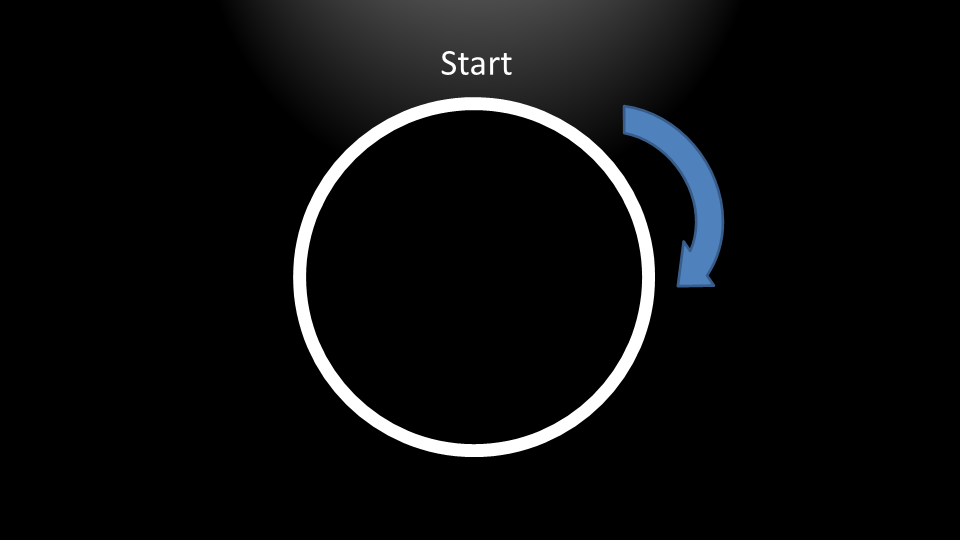
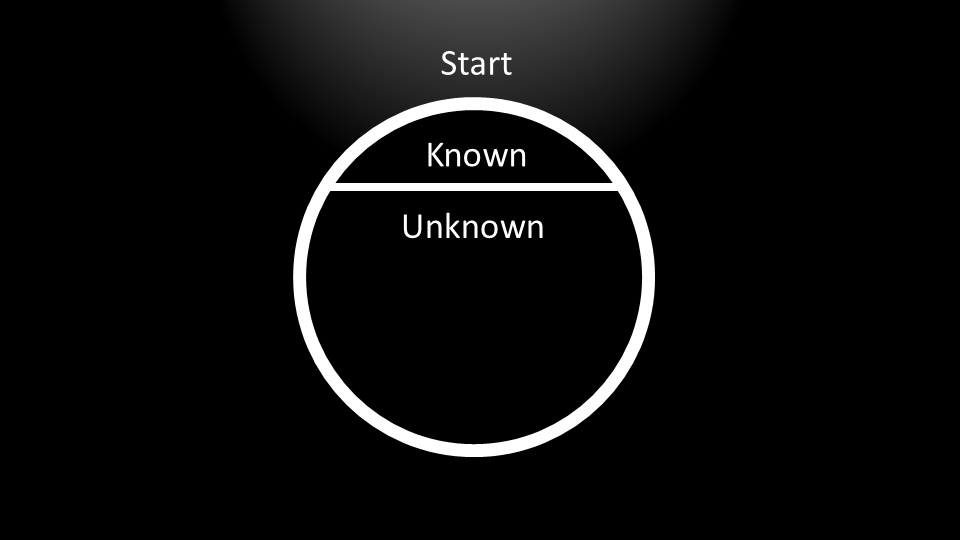
The Hero’s Journey theory says good stories are circular. You end up back where you started. They’re a journey from home, from comfort, from the concious, down into the subconscious, uncomfortable far away place, and back eventually home again. Of course, changes happen along the way.
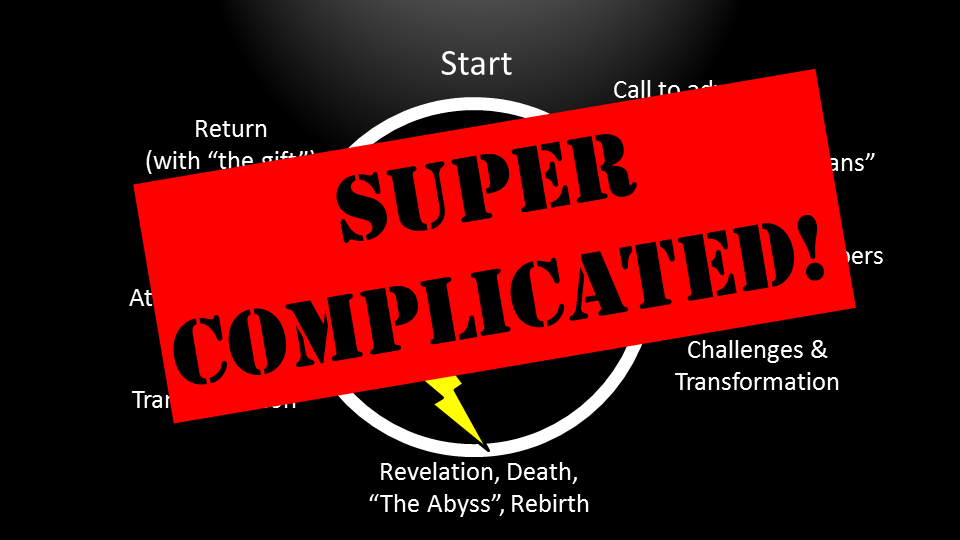
The full theory has all kinds of Freudian stuff to do with being forced out of the mothers arms by the call of the father, eventually defeating the father, and returning eventually as a mother or father all that… (Seriously, Freud had issues.) Also, there’s loads of details that are reasonably important, and do make the story more compelling, but also, with much added complexity. So lets go look at Dan Harmon’s Story Circle instead.
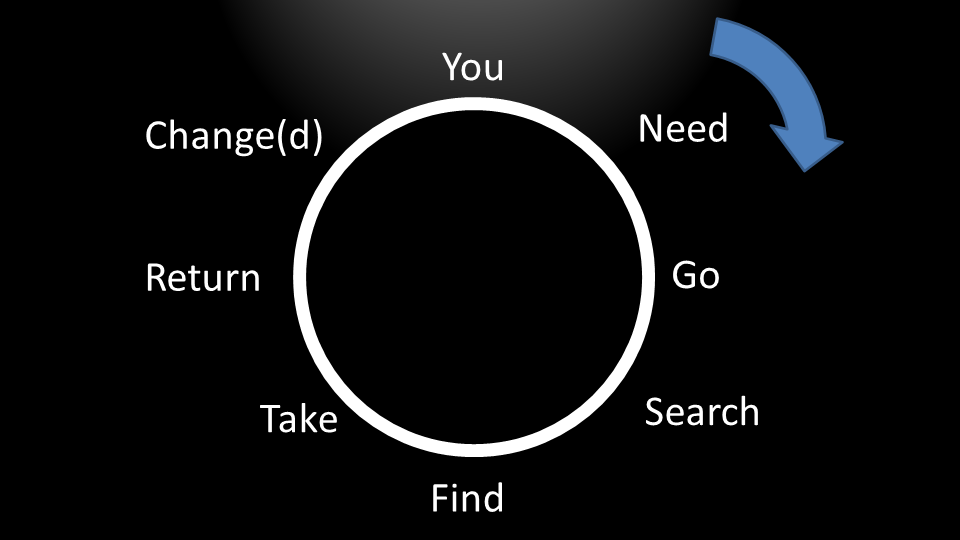
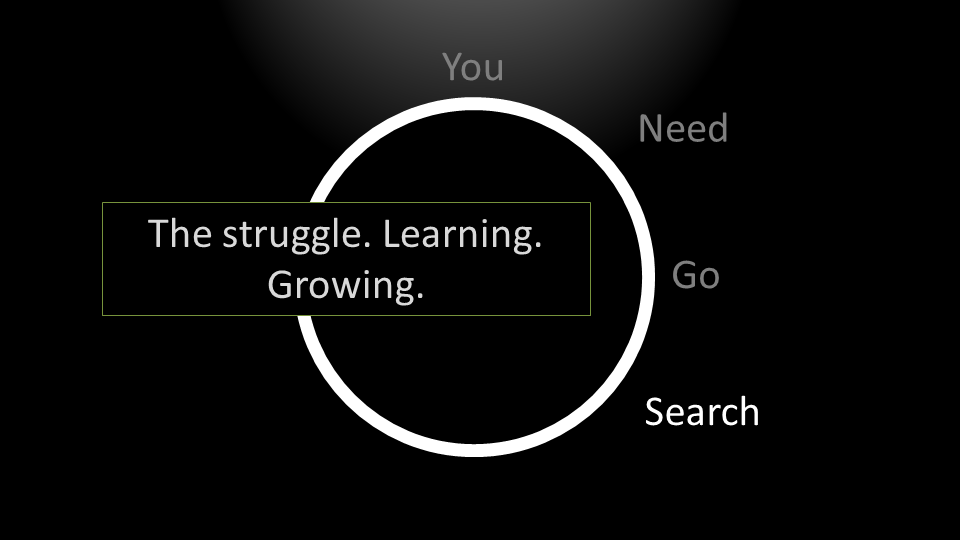
He takes the circle concept, and breaks it into 8 simple parts.
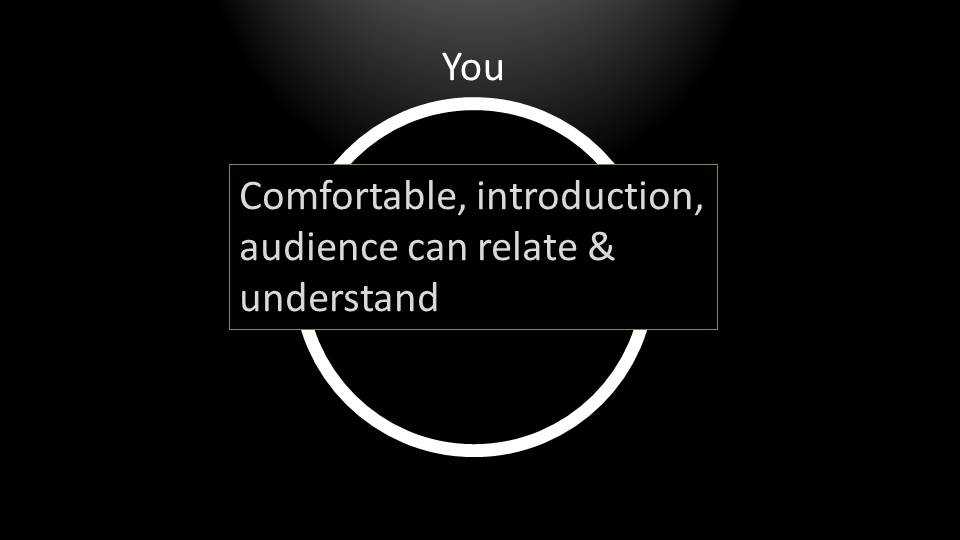
We start off at " You". This is where " you" the audience relate to the main character(s). Preferably, the character should be in a place of comfort, or at least, be connected to some kind of easy-to-relate-to “home” situation. This could be a sailor at sea on the bridge, or a little bear playing a balancing game, or Garion at Faldor’s farm, a new student enrolling at community college, etc. It’s a starting point that the audience can relate to, and feel comfortable understanding. They don’t have to dig deep emotionally to connect with the main character. It happens automatically. This is the concious, mental understanding area.
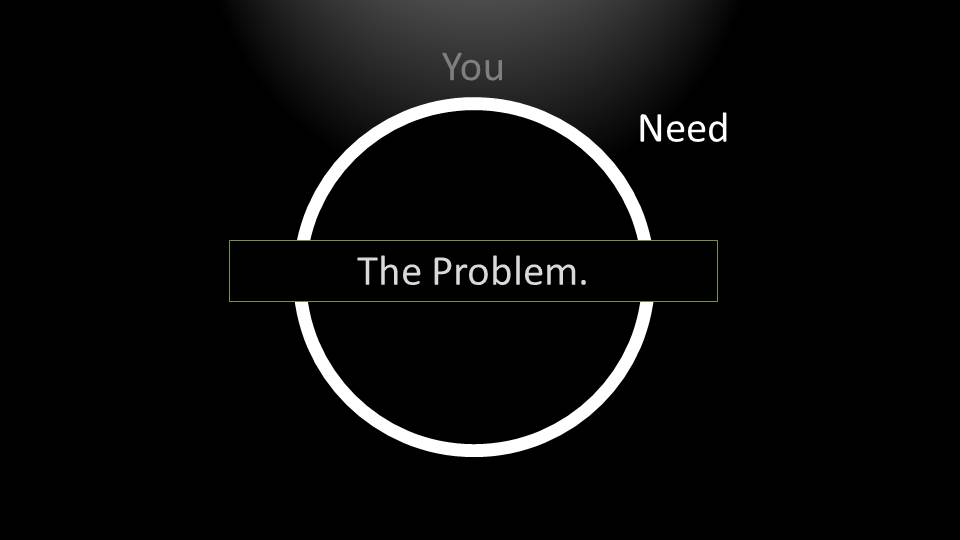
Next is the " need". Something isn’t right, or some how the stable situation will be pushed off-balance. This is pretty close to the “problem” concept from the 3-act play model. Note, we’re still basically in the stable conciousness.
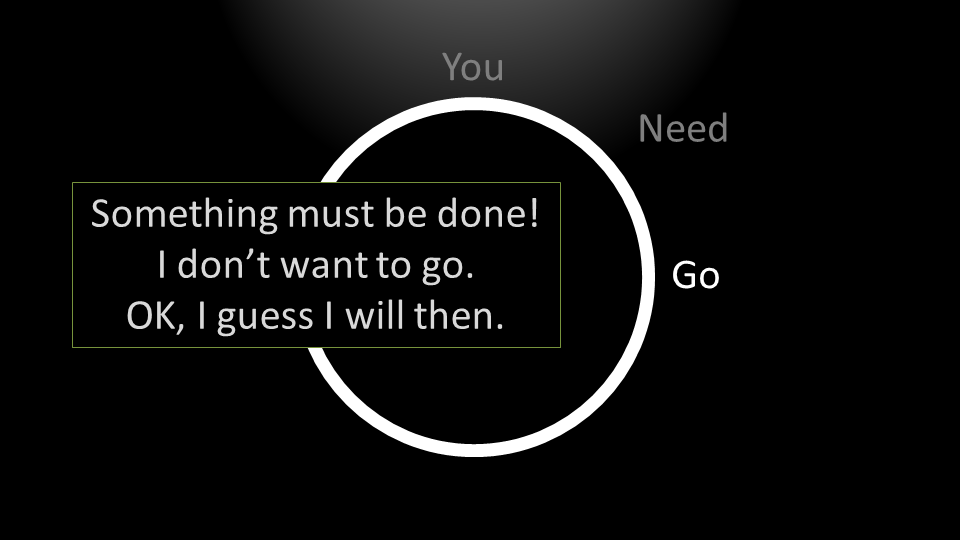
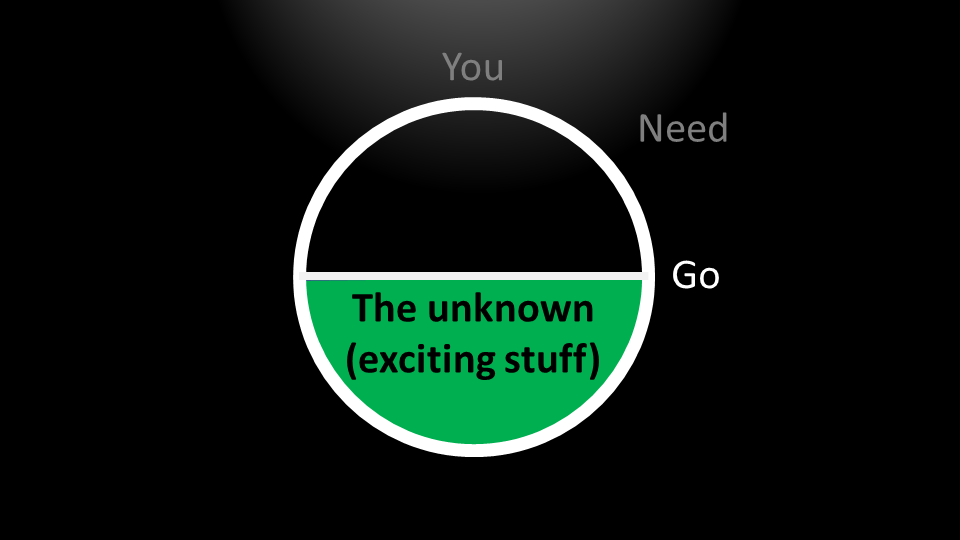
So, since there’s a need, I guess we’d better " Go" do something about it. This is where the Hero decides to actually leave their safe familiar environment, and go out into the world to solve the problem. We finally dep art the concious, and head into the scary subconscious / unconscious. The go ing can often be the most emotional part of the story. Or at least, the most emotionally motivated or driven part. Once the Hero is actually off fighting dragons and saving maidens, they’re too busy actually doing stuff to be all soppy and emotional.
Now that we’ve actually left, comes the big difficult part of the story, the Seek ing, or Search ing. We may not exactly know what it is we’re looking for yet - but we’ll find out. Many different avenues can be explored, different people met, etc. This can be long, arduous, and challenging. The main character should be growing and changing here.
Recently I had the opportunity to do a workshop / seminar with the Logos Hope Events team about Theatre & Storytelling. I love theatre, and am very passionate about making (especially Childrens’) events into engaging stories, rather than just variety shows with a 5 minute message tacked on the end.
This is kind of a summary of what I covered, with some of the slides I made. There’s quite a lot of content, so I’m splitting it up into 3 posts.
Storytime!
To start off, we looked at 3 of David’s books, which I brought along.
Mealtime
Peekaboo Forest
Good Night, Little Bear
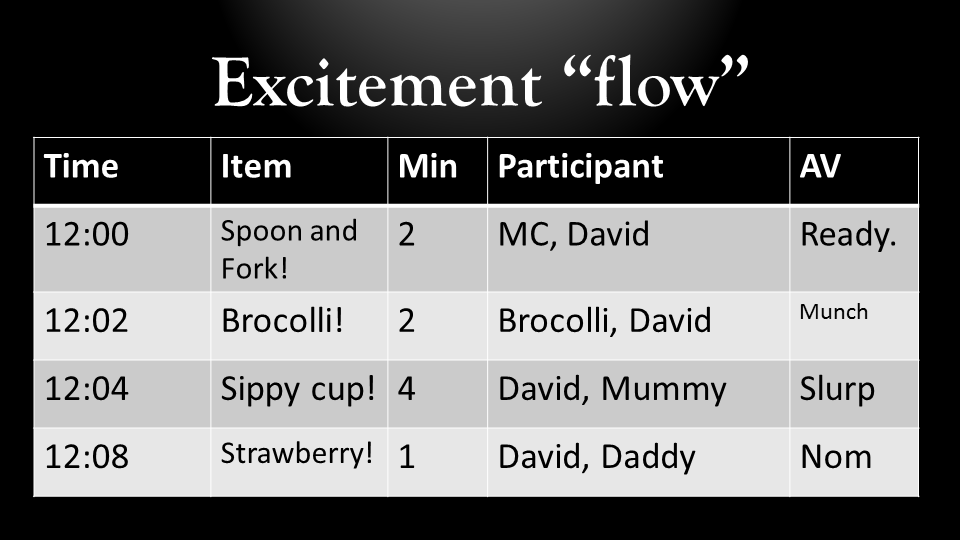
Mealtime is basically just a list of items you might find at mealtimes:
Spoon and Fork,
Brocolli,
Sippy cup,
Strawberry...
and so on. Not staggeringly inspiring. Often, however, events are organised in a similar manner. Get a list of things we want to put in (Introduction video, Korean fan dance, Refreshments, Sermon, Singing), have an MC or host link them all together (“Wow, that was amazing. Next we have…”) and suddenly you’ve got a programme.
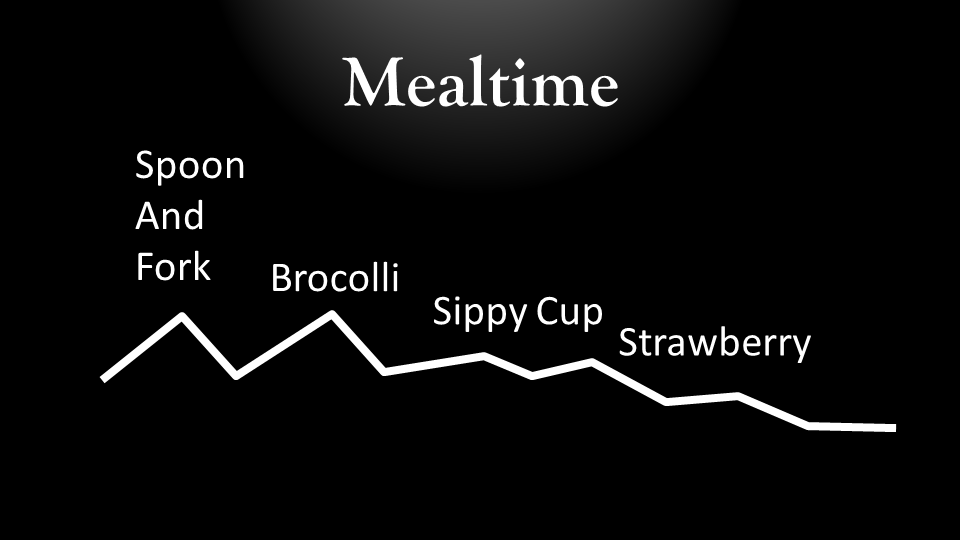
In terms of energy levels of the audience, it looks something like this: Each individual item may be all right, but they’re not really connected, and nothing really keeps the attention. And it doesn’t get more exciting, and … well. I forgot what I was … er, better check facebook.
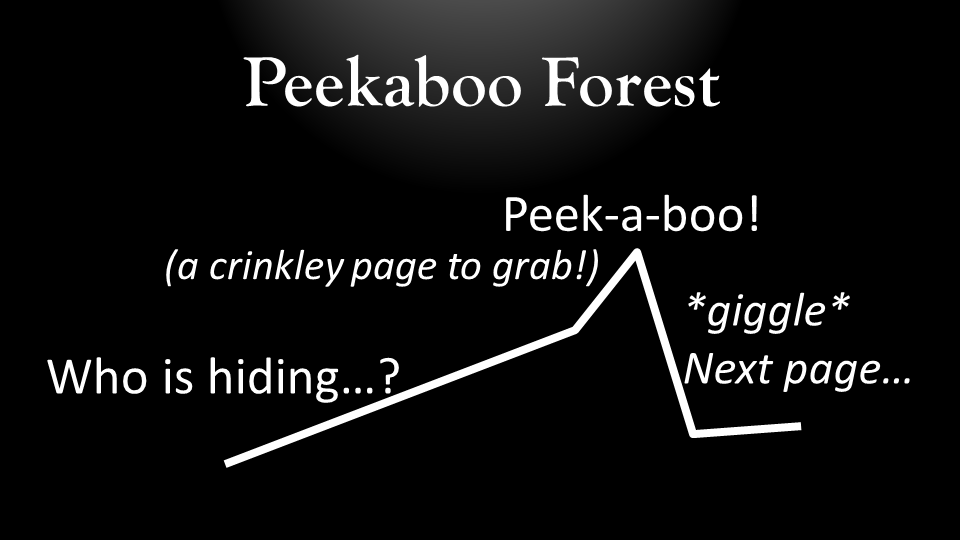
Peekaboo Forest is quite a bit better. Each page asks a question:
‘Who is hiding behind the spruce?’
there’s then a nice crinkly page to turn over:
Peek-a-boo! It’s the Moose!
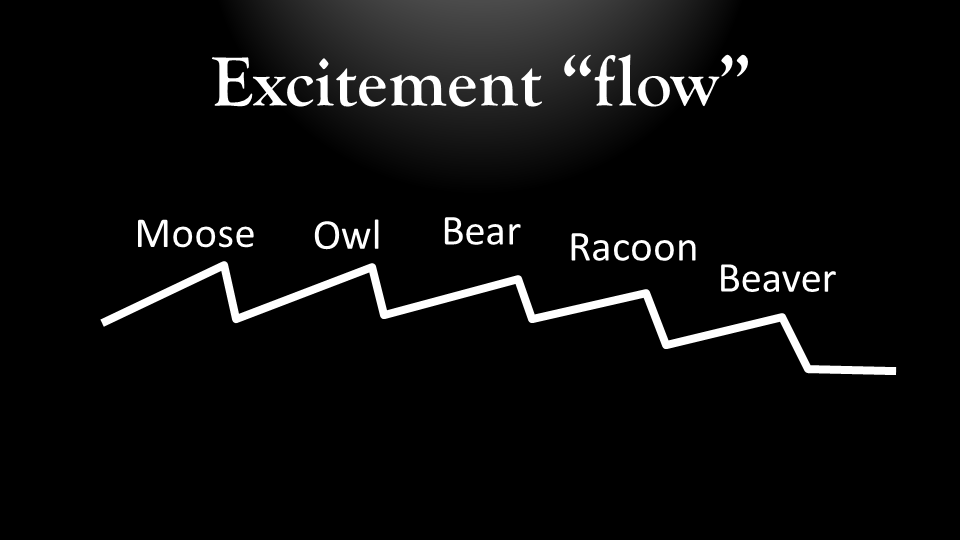
So each page has quite a nice “energy” flow:
with good anticipation, etc. But in terms of overall story-arc, it’s very dull.
It really doesn’t go anywhere, and often programmes are like that too. Each individual item may be great, but you don’t lead the audience anywhere, and don’t have everything tied together.
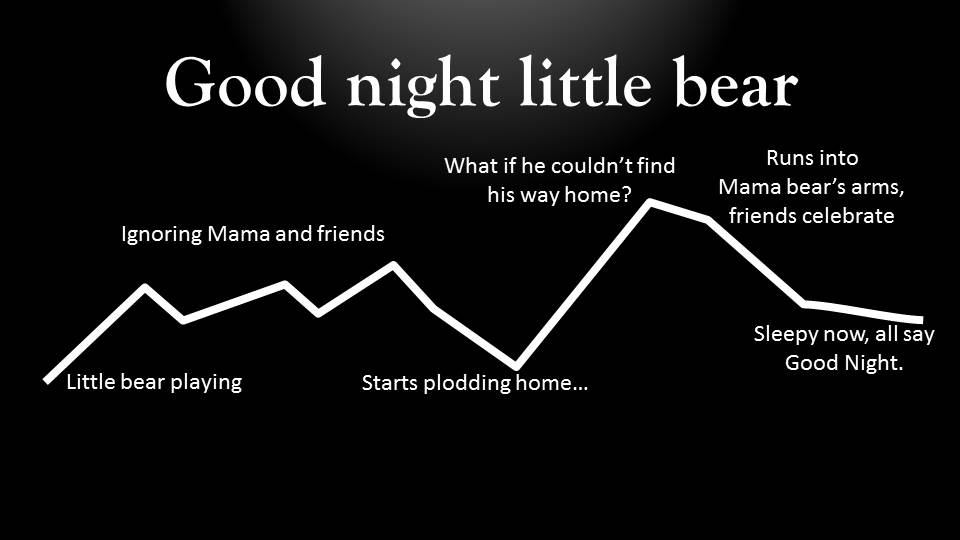
Good Night, Little Bear is much more interesting. We read this to David almost every night, and even though it doesn’t have crinkly pages, he still seems to really enjoy it. The story is (essentially) little bear not wanting to go to bed, instead he goes off to play, until eventually he watches the sunset, it gets dark, and he realises he should have listened to Mama bear, and in fact he’s lost now and can’t find his way home. But then Mama bear, assisted by Little Bear’s friends, Mouse and Squirrel, come to find Little Bear. He hears them calling him, and runs to Mama Bear’s arms. He’s now feeling tired, and goes to bed. It’s really well told, with lovely pictures, and so on.
A much more complex rough energy flow chart.
So that’s the “energy flow” concept. Reasonably simple to grasp. If we are making an event which is a variety show / sandwhich programme, or a concert, then it’s worth thinking about this stuff, and saying “How do we want to start? Something big and fun to grab the attention, and then we can settle down a bit, work our way up to a climax, and then slowly bring it to a close…”.
I use WordPress at work, it’s the engine behind fr.om.org, transform.om.org and most of the other sites that we run for clients.
I’m in two minds as to whether I like it or not. Some things are great. For users (content authors, the people writing blog posts or static pages), it’s fine. Easy to understand and use. For writing plugins and templates, it’s… Well, kind of messy and ugly, but doable. For instance, rather than have 1 HTML template “base” file, with a block saying, “put posts here, and wrap each one in x,y,z”, you have a header.php which has only the start of all the HTML, and a footer.php which closes it all, and a content.php, a content-post.php, and so on, and you have to keep them all synced up. Also, since it’s designed for running on old PHP, it doesn’t use namespaces or other ways of keeping code clean, so all functions in all plugins and all templates are all global scope, so to avoid bumping in to each other, you have to name all your functions stuff like, “madprofs_teapot_plugin_get_resource() and similar. Then at the same time, Wordpress has multiple global functions of its own, some called things like, the_post(), others like wp_get_cached(), (so prefixed with wp_), and others in other styles. Messy.
Still, it gets the job done.
So when I wanted to update and clean up the brummie@sea blog, I thought I’d just stick with blogger. It works, it’s what I already had. But then, accidentally, while trying to update it, I lost the entire design, and putting it back together was this awful mess of Google-XML/HTML confusion, I thought, “you know, stuff it, I’ll just use WordPress.” So I span up a site on the server (in about 2 minutes), pointed the blogger importer at brummieatsea.blogspot.com, let it chug away for a few minutes, and here we are.
I’m just using a very simple built in design for now, (with my own background), but it seems to work. I now don’t have to worry about Google turning off blogger like they did with Reader and GoogleCode, and since I use Wordpress at work, I understand what’s going on pretty well.
That all said, we’re now on the ship, trying to settle in. We have a really nice cabin. Jet lag wasn’t fun, especially with the baby, but we’ll get through it. Yesterday Becky drank a big milky drink by accident - we thought it wasn’t cows milk but plant based, and last night and tonight David has been awful - screaming for ages and refusing to be comforted or to sleep lying down in his bed. So that does seem to confirm that maybe it is a lactose intolerance at the moment - hopefully he’s back to normal in a day or so.
Work so far is just cleaning the various venues. We’ve not even begun to start installing new equipment or doing anything really technical. We’ve got the lights out of their bags and air-blasted them all, cleaned many surfaces and TVs and vacuumed and dusted. It’s going alright. Still sooo much to do.