So this is Part 3 of my seminar / workshop on Story Telling that I did with the Logos Hope On-Board events Team. Here’s Part 1, and Part 2.
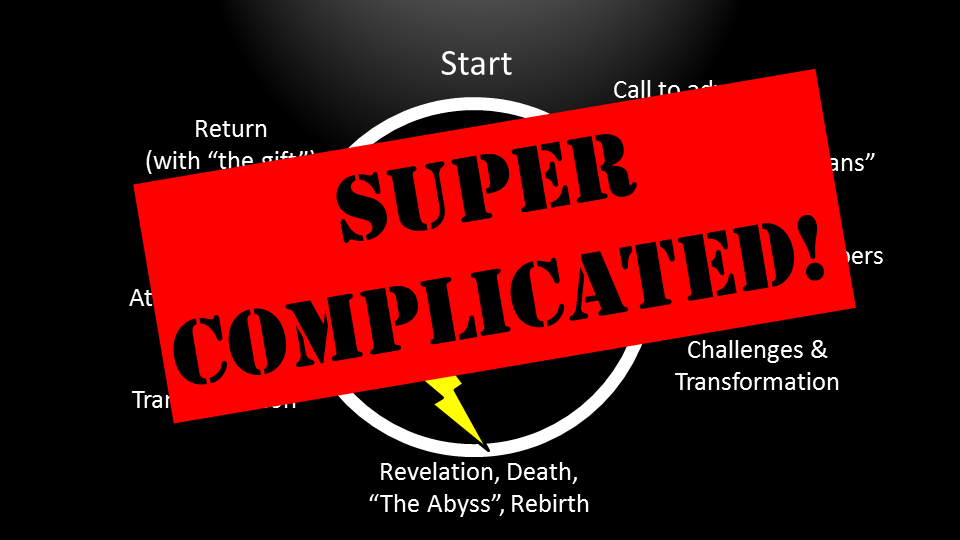
There’s an interesting alternative theory called, “The Hero’s Journey” (or “Monomyth”). There’s books written about this, some really cool ideas. A very approachable version is by Dan Harmon, the creator of Community. Ant Webb was the guy who introduced me to both Community, and the Hero’s Journey. We’ve been discussing it and used it as part of Matt’s Blog.
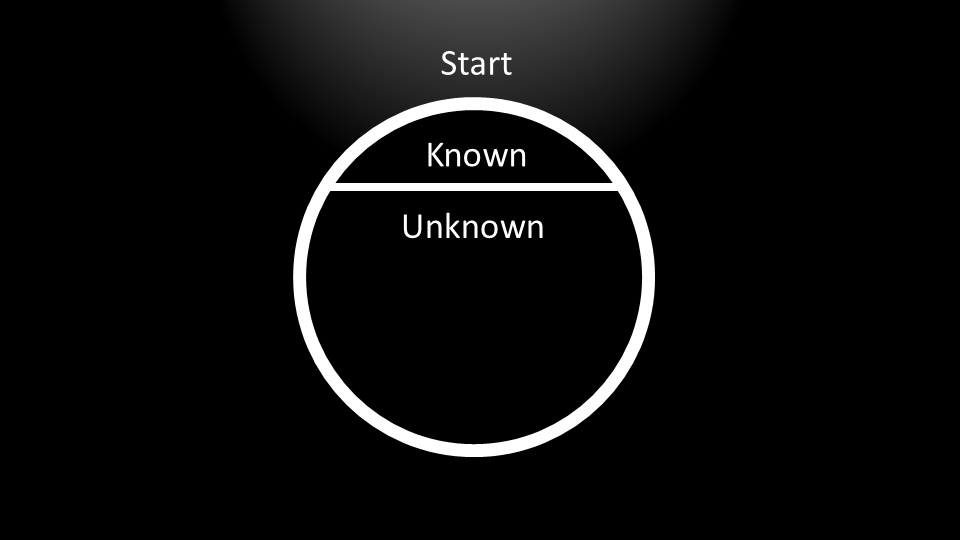
The Hero’s Journey theory says good stories are circular. You end up back where you started. They’re a journey from home, from comfort, from the concious, down into the subconscious, uncomfortable far away place, and back eventually home again. Of course, changes happen along the way.
The full theory has all kinds of Freudian stuff to do with being forced out of the mothers arms by the call of the father, eventually defeating the father, and returning eventually as a mother or father all that… (Seriously, Freud had issues.) Also, there’s loads of details that are reasonably important, and do make the story more compelling, but also, with much added complexity. So lets go look at Dan Harmon’s Story Circle instead.
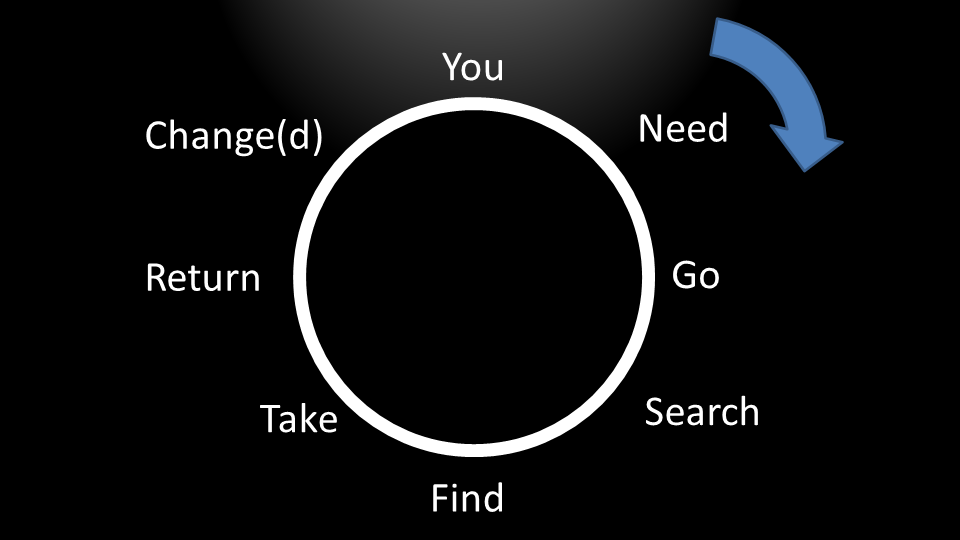
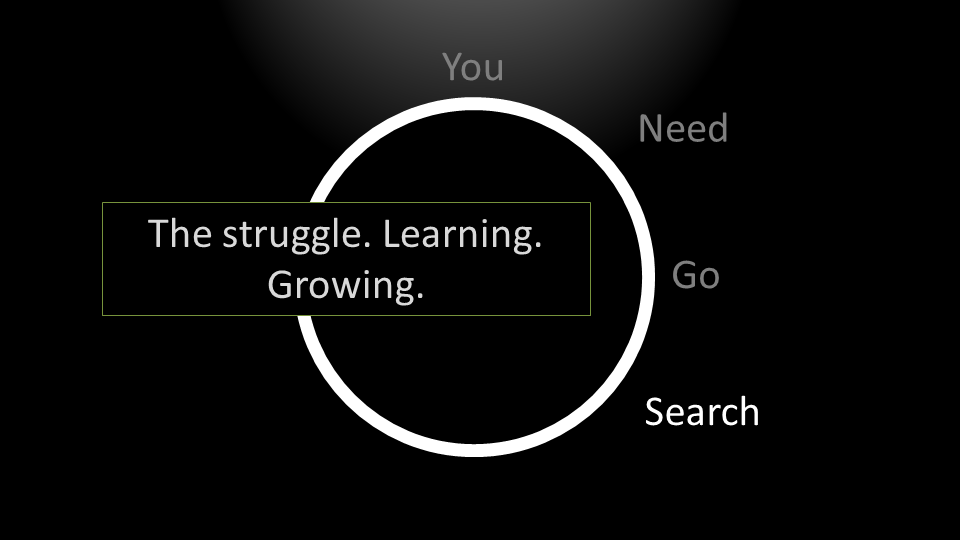
He takes the circle concept, and breaks it into 8 simple parts.
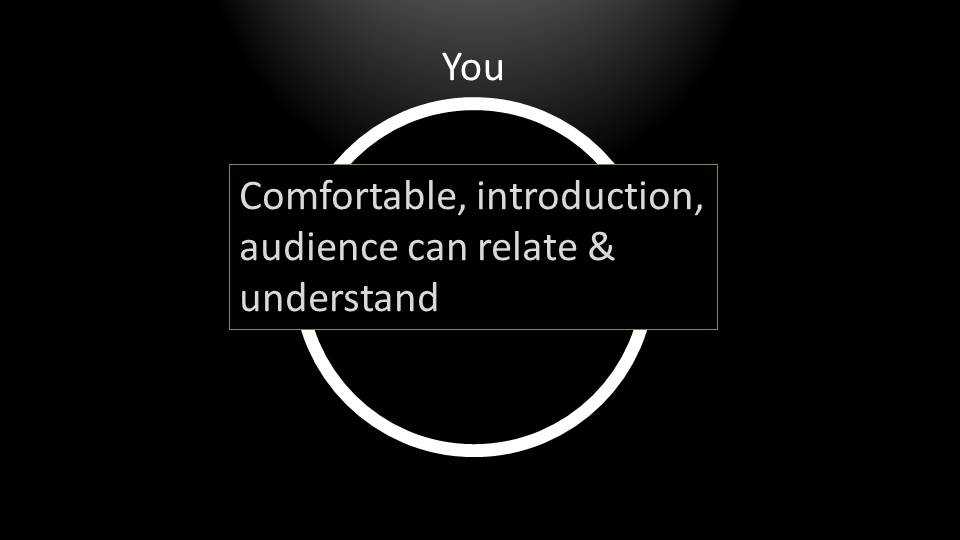
We start off at " You". This is where " you" the audience relate to the main character(s). Preferably, the character should be in a place of comfort, or at least, be connected to some kind of easy-to-relate-to “home” situation. This could be a sailor at sea on the bridge, or a little bear playing a balancing game, or Garion at Faldor’s farm, a new student enrolling at community college, etc. It’s a starting point that the audience can relate to, and feel comfortable understanding. They don’t have to dig deep emotionally to connect with the main character. It happens automatically. This is the concious, mental understanding area.
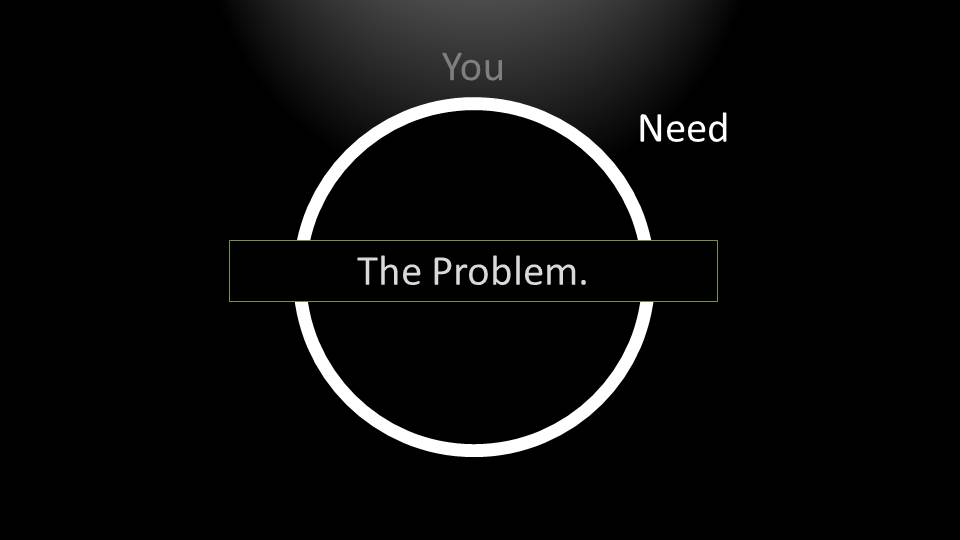
Next is the " need". Something isn’t right, or some how the stable situation will be pushed off-balance. This is pretty close to the “problem” concept from the 3-act play model. Note, we’re still basically in the stable conciousness.
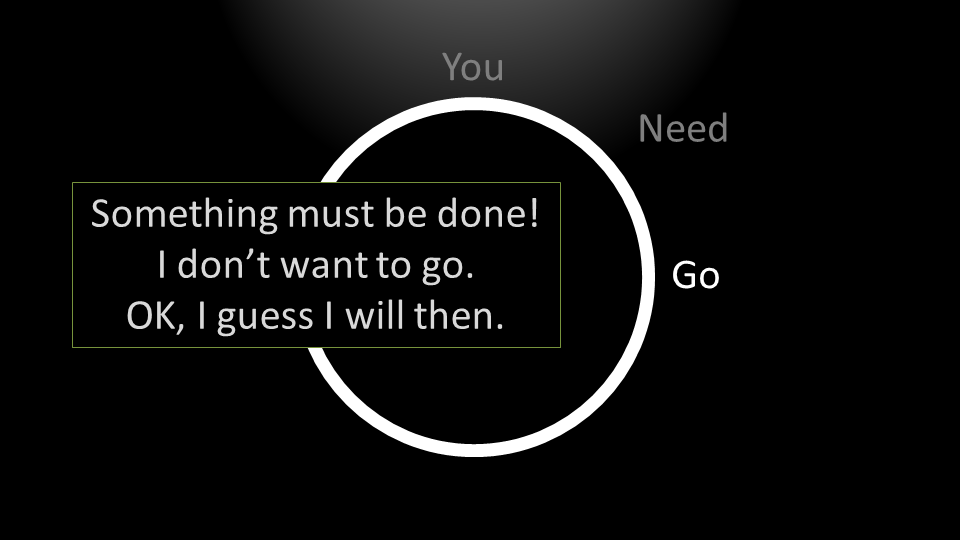
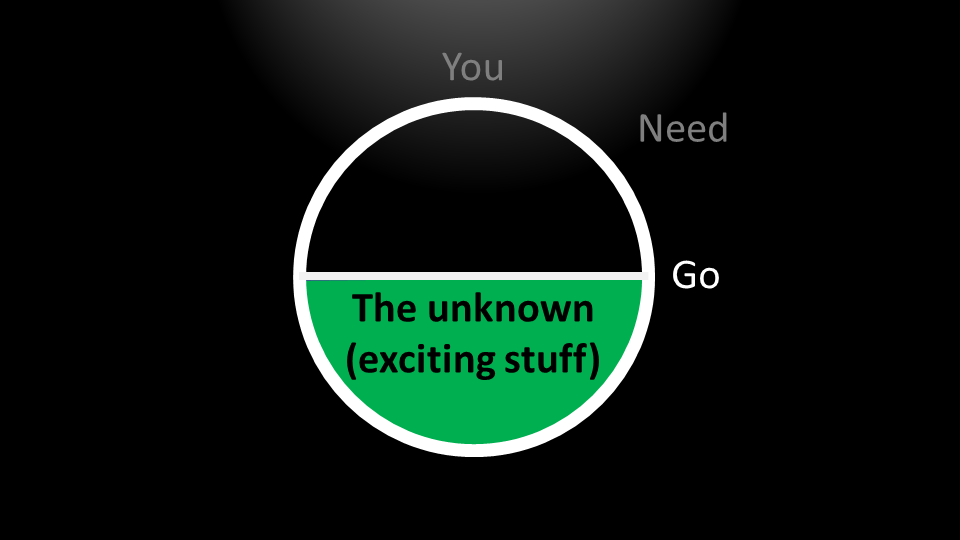
So, since there’s a need, I guess we’d better " Go" do something about it. This is where the Hero decides to actually leave their safe familiar environment, and go out into the world to solve the problem. We finally dep art the concious, and head into the scary subconscious / unconscious. The go ing can often be the most emotional part of the story. Or at least, the most emotionally motivated or driven part. Once the Hero is actually off fighting dragons and saving maidens, they’re too busy actually doing stuff to be all soppy and emotional.
Now that we’ve actually left, comes the big difficult part of the story, the Seek ing, or Search ing. We may not exactly know what it is we’re looking for yet - but we’ll find out. Many different avenues can be explored, different people met, etc. This can be long, arduous, and challenging. The main character should be growing and changing here.
This is the second part of a 3 part series, transcribing / “article-ifying” a training seminar I ran with the on-board events team on the Logos Hope. Here’s a link to the first part.
Aristotle and a suuuper simple model
Waaay back in 350 or so BC, a clever Greek dude (Aristotle) said that he reckoned a good story (or theatrical performance) had 3 parts to it:
Beginning
Middle
End
Yep. It’s what you’re taught in primary school creative writing. Expanding those a bit:
Beginning: Introduction to the main characters, and “The Problem”
Middle: The struggle or conflict, where the main characters confront “The Problem”
End: Where either the main characters or “The Problem” win, and everything resolves.
In some ways, the most important thing from this is that without a problem, there is no story. There has to be “something rotten in the state of Denmark”. Or else what keeps your audience more interested in the programme, than in what’s on their phones?
“3 act plays”
Taking this concept a bit further, is the traditional “3 act play”. Often our events aren’t done in acts, but the concepts are useful for thinking, “Where should I put the refreshment breaks?” and thinking how the story energy levels should map out best. Whether or not you actually use this model, it’s still an interesting one to look at, and see if it helps you.
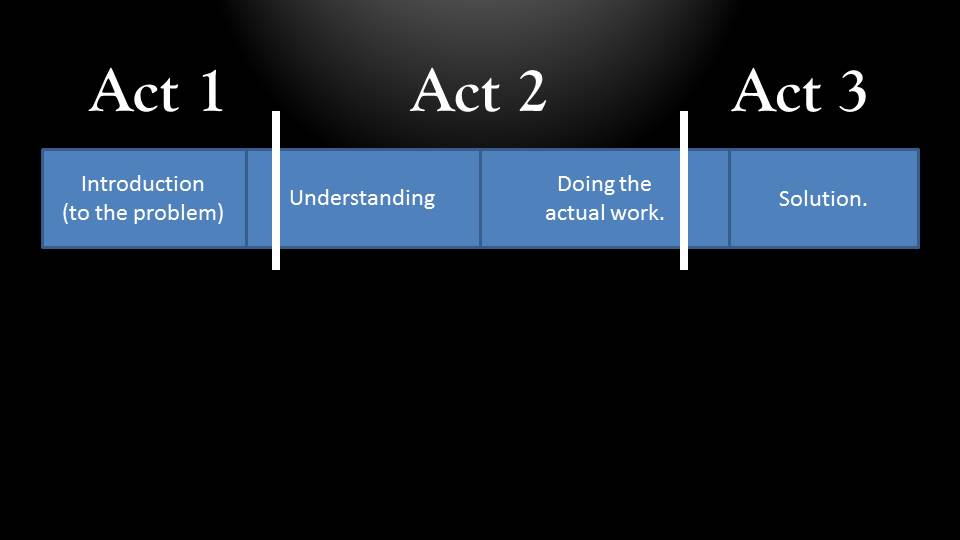
The 3 acts are pretty close to the “beginning, middle, end” concepts from before, but expanded.
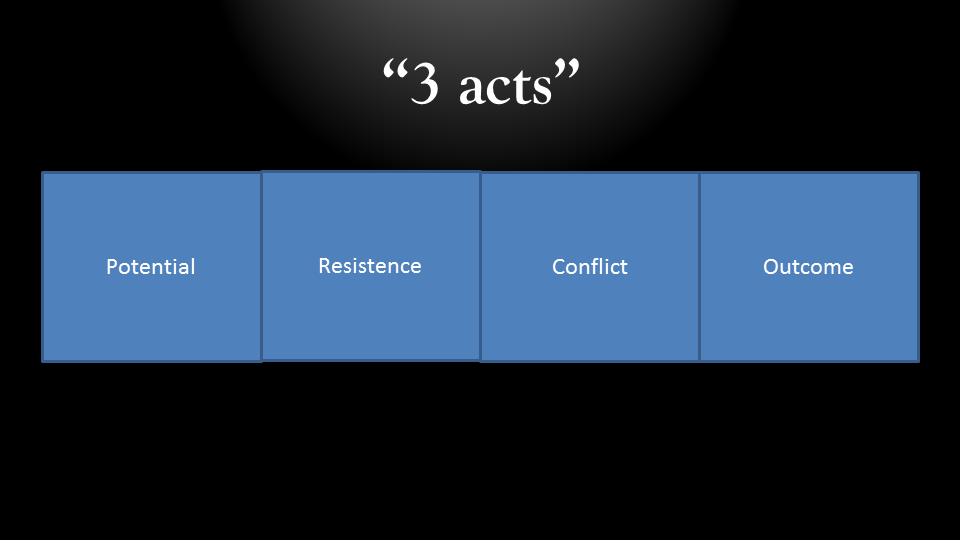
Confusingly, sometime the 3-act-play can be broken down in to 4 parts:
which progresses through the main character (and audiences’) perception of ‘The Problem’.
There’s “potential” for an interesting story - you set up the main character(s), and the problem. But they’re not actually in conflict yet (at least, as far as this specific narrative goes.) There’s resistance to the conflict - things get in the way, the problem isn’t fully understood yet, etc. Finally the conflict itself, actually doing something, rather than just trying to understand the problem, and finally the outcome, and cleaning up.
I mentioned that the Main Character and the Problem may not be in actual conflict yet. Just to note here, this is for the purposes of this narrative. For instance, in David and Goliath, Israel and Phillistia are at war at the beginning of the story. However, the Main Character, David, isn’t actually in personal conflict with Goliath, until much later.
So how do these 4 parts map onto a “3 act play”?
Act 1.
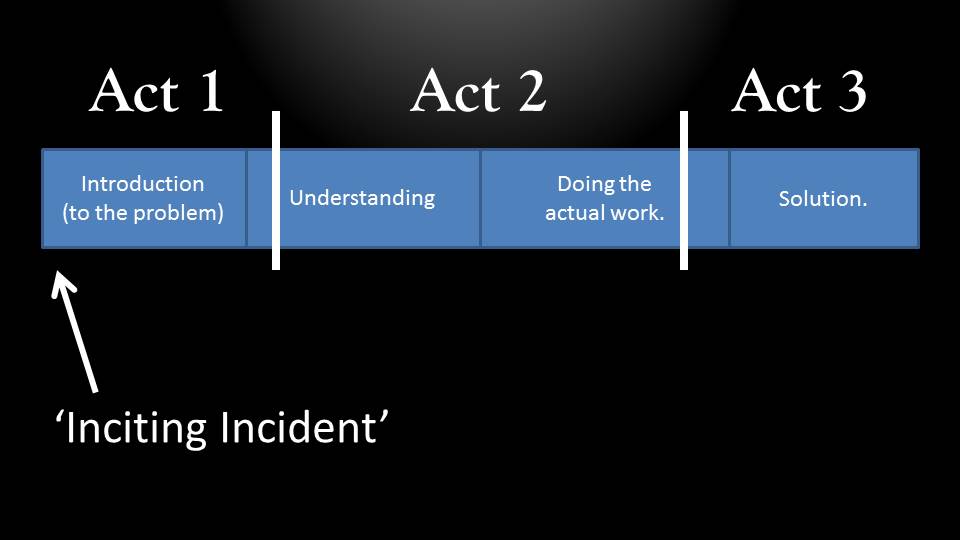
Starting off the play, you need some kind of event which introduces the reason for the story.
The children of Israel are at war with the Philistines. Jeff Winger starts at his new Community College; Darth Vader boards Princess Leia’s diplomatic space ship and takes her prisoner; The orb of Aldur is stolen; Little Bear is playing, and it’s getting late. Sometimes, this is called the ‘inciting incident’.
One thing to note is that this might not involve the main character. It’s setting the scene for the whole rest of the story, and may in fact be the cause for many different stories to happen. A murder has happened, but at least so far, the main character may not yet have been put on the case.