I think I should start writing again. I’ve realised how much I miss it.
I don’t know how often I’ll manage it - but we’ll see.
Brief update for the sake of historical thingness (as Euan might say):
We’re back on the Logos Hope - 4 of us now. This time for probably 2 years. We’ve been on board almost a year now, and are currently on break (thus finding the time for writing, and motivation to start again).
Life on the ship is spectacularly busy with 2 children. Essentially any time that’s not work, while the kids are awake I try to spend with them. And when they’re asleep, then with my wife. But I’m realising I do need more introvert / me time to help make the time with kids+wife better quality.
Blogging kind of takes a back-seat - as I feel like the writing I want to be doing is all fiction, and the writing I should be doing is all email / work related.
Anyway, hopefully writing here helps me feel more inspired to write other stuff that I need to. And also is perhaps interesting for you, dear reader.
This is the second part of a 3 part series, transcribing / “article-ifying” a training seminar I ran with the on-board events team on the Logos Hope. Here’s a link to the first part.
Aristotle and a suuuper simple model
Waaay back in 350 or so BC, a clever Greek dude (Aristotle) said that he reckoned a good story (or theatrical performance) had 3 parts to it:
Beginning
Middle
End
Yep. It’s what you’re taught in primary school creative writing. Expanding those a bit:
Beginning: Introduction to the main characters, and “The Problem”
Middle: The struggle or conflict, where the main characters confront “The Problem”
End: Where either the main characters or “The Problem” win, and everything resolves.
In some ways, the most important thing from this is that without a problem, there is no story. There has to be “something rotten in the state of Denmark”. Or else what keeps your audience more interested in the programme, than in what’s on their phones?
“3 act plays”
Taking this concept a bit further, is the traditional “3 act play”. Often our events aren’t done in acts, but the concepts are useful for thinking, “Where should I put the refreshment breaks?” and thinking how the story energy levels should map out best. Whether or not you actually use this model, it’s still an interesting one to look at, and see if it helps you.
The 3 acts are pretty close to the “beginning, middle, end” concepts from before, but expanded.
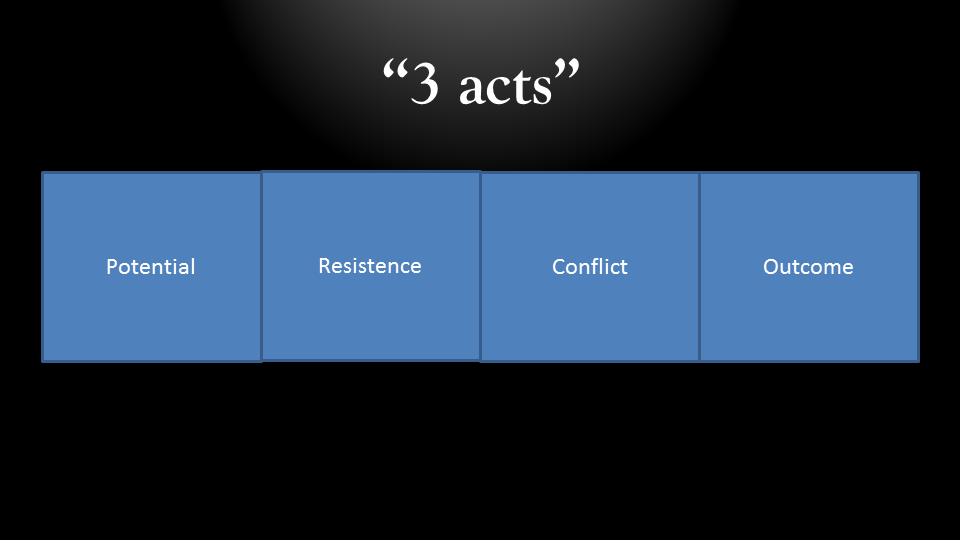
Confusingly, sometime the 3-act-play can be broken down in to 4 parts:
which progresses through the main character (and audiences’) perception of ‘The Problem’.
There’s “potential” for an interesting story - you set up the main character(s), and the problem. But they’re not actually in conflict yet (at least, as far as this specific narrative goes.) There’s resistance to the conflict - things get in the way, the problem isn’t fully understood yet, etc. Finally the conflict itself, actually doing something, rather than just trying to understand the problem, and finally the outcome, and cleaning up.
I mentioned that the Main Character and the Problem may not be in actual conflict yet. Just to note here, this is for the purposes of this narrative. For instance, in David and Goliath, Israel and Phillistia are at war at the beginning of the story. However, the Main Character, David, isn’t actually in personal conflict with Goliath, until much later.
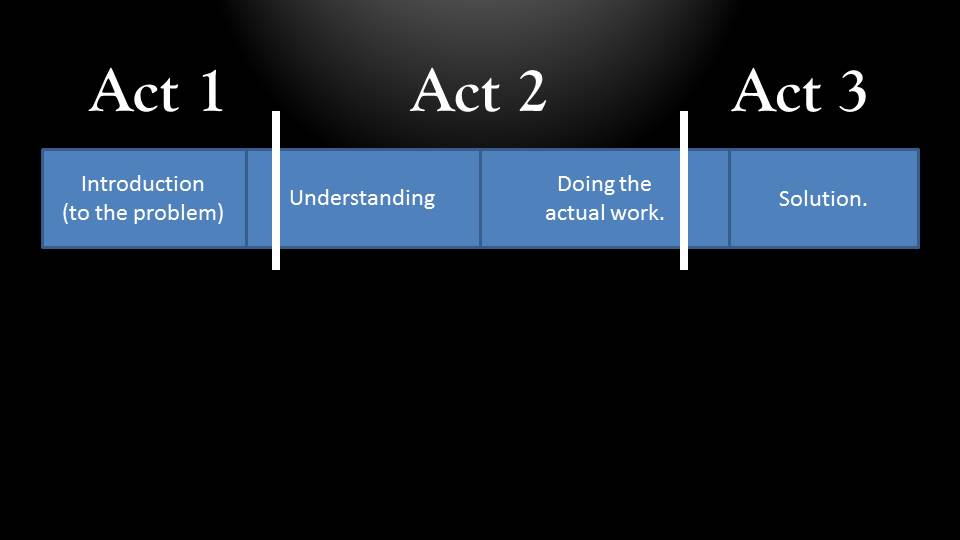
So how do these 4 parts map onto a “3 act play”?
Act 1.
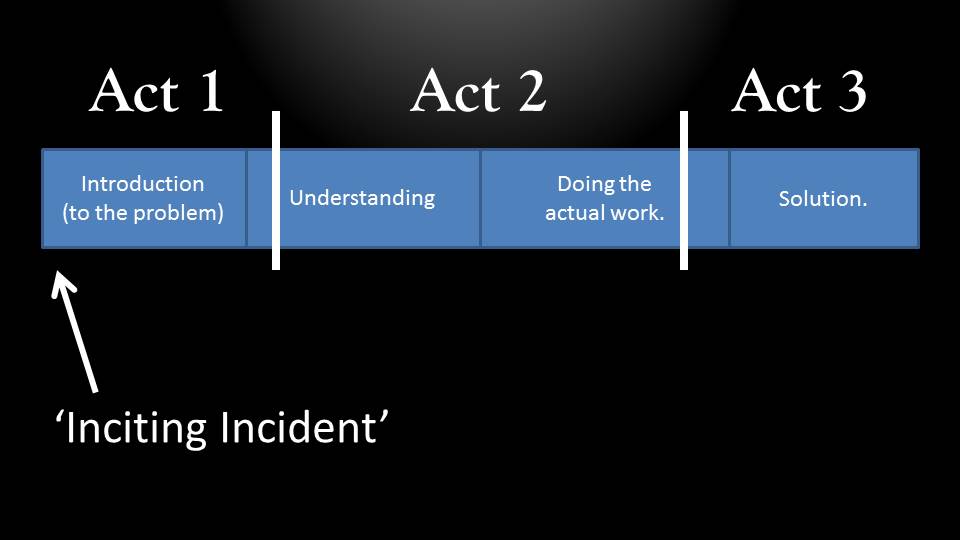
Starting off the play, you need some kind of event which introduces the reason for the story.
The children of Israel are at war with the Philistines. Jeff Winger starts at his new Community College; Darth Vader boards Princess Leia’s diplomatic space ship and takes her prisoner; The orb of Aldur is stolen; Little Bear is playing, and it’s getting late. Sometimes, this is called the ‘inciting incident’.
One thing to note is that this might not involve the main character. It’s setting the scene for the whole rest of the story, and may in fact be the cause for many different stories to happen. A murder has happened, but at least so far, the main character may not yet have been put on the case.
Recently I had the opportunity to do a workshop / seminar with the Logos Hope Events team about Theatre & Storytelling. I love theatre, and am very passionate about making (especially Childrens’) events into engaging stories, rather than just variety shows with a 5 minute message tacked on the end.
This is kind of a summary of what I covered, with some of the slides I made. There’s quite a lot of content, so I’m splitting it up into 3 posts.
Storytime!
To start off, we looked at 3 of David’s books, which I brought along.
Mealtime
Peekaboo Forest
Good Night, Little Bear
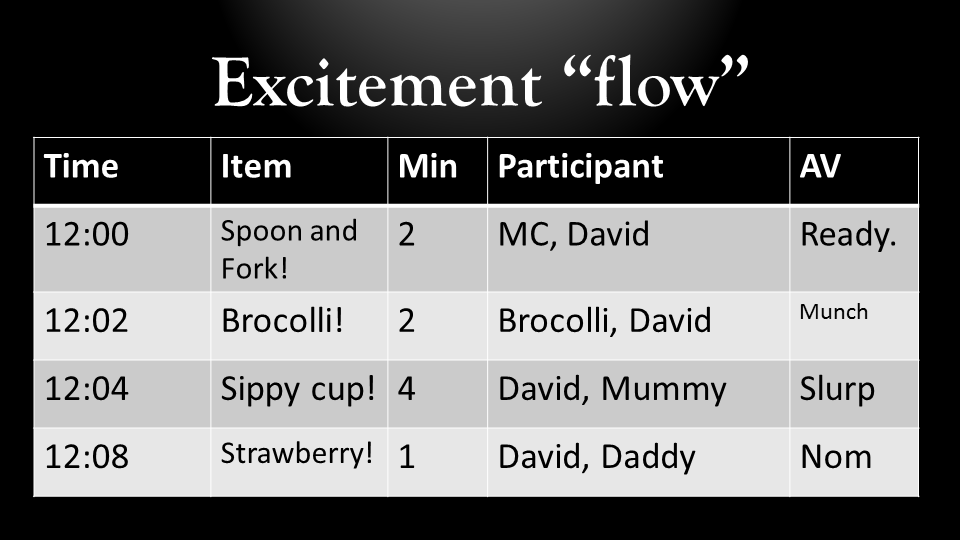
Mealtime is basically just a list of items you might find at mealtimes:
Spoon and Fork,
Brocolli,
Sippy cup,
Strawberry...
and so on. Not staggeringly inspiring. Often, however, events are organised in a similar manner. Get a list of things we want to put in (Introduction video, Korean fan dance, Refreshments, Sermon, Singing), have an MC or host link them all together (“Wow, that was amazing. Next we have…”) and suddenly you’ve got a programme.
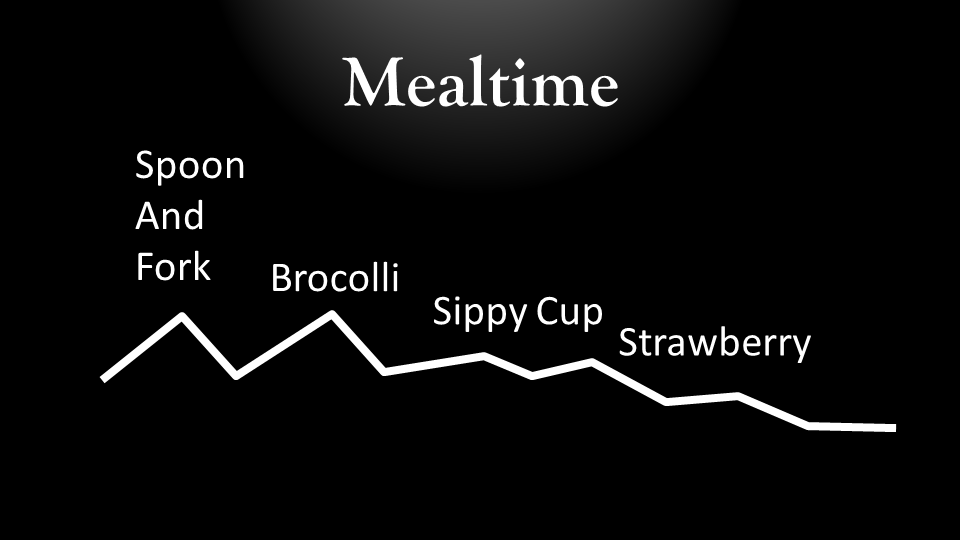
In terms of energy levels of the audience, it looks something like this: Each individual item may be all right, but they’re not really connected, and nothing really keeps the attention. And it doesn’t get more exciting, and … well. I forgot what I was … er, better check facebook.
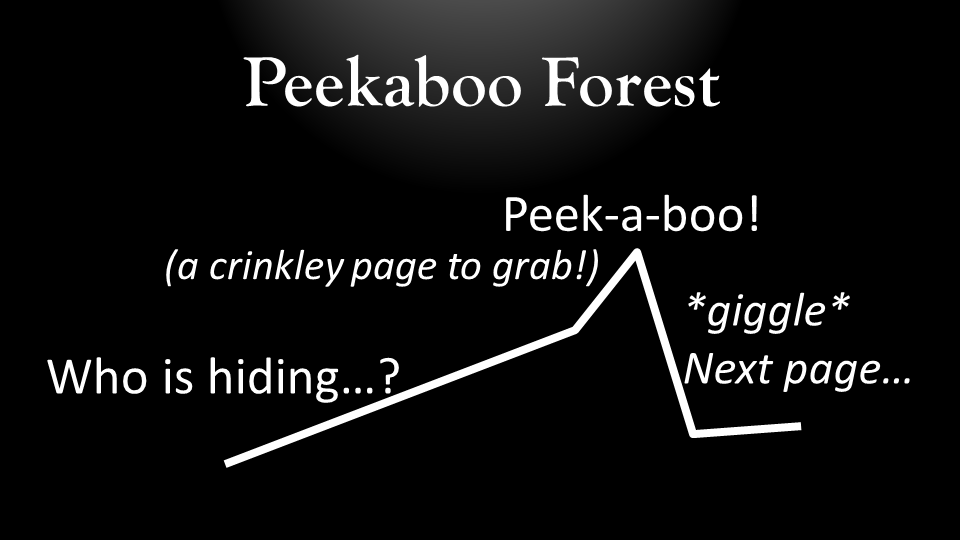
Peekaboo Forest is quite a bit better. Each page asks a question:
‘Who is hiding behind the spruce?’
there’s then a nice crinkly page to turn over:
Peek-a-boo! It’s the Moose!
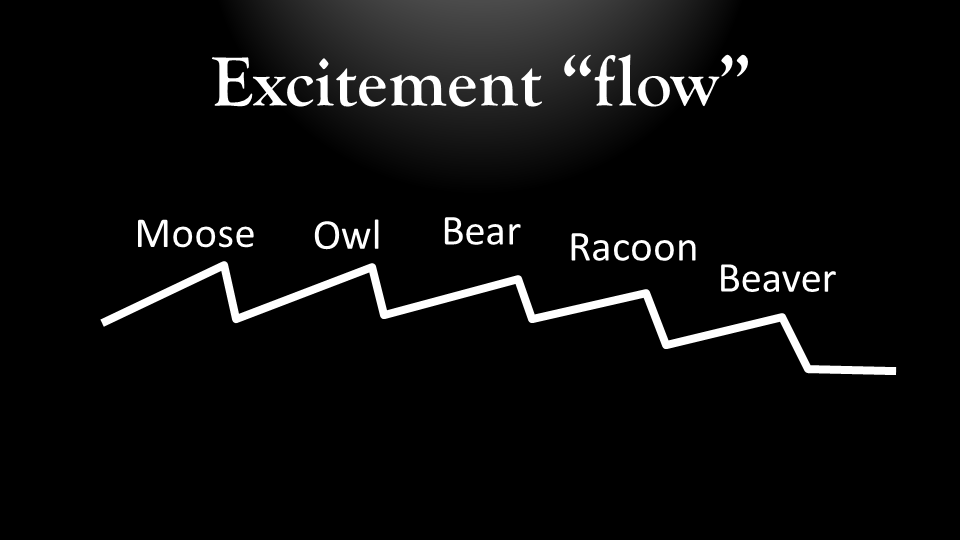
So each page has quite a nice “energy” flow:
with good anticipation, etc. But in terms of overall story-arc, it’s very dull.
It really doesn’t go anywhere, and often programmes are like that too. Each individual item may be great, but you don’t lead the audience anywhere, and don’t have everything tied together.
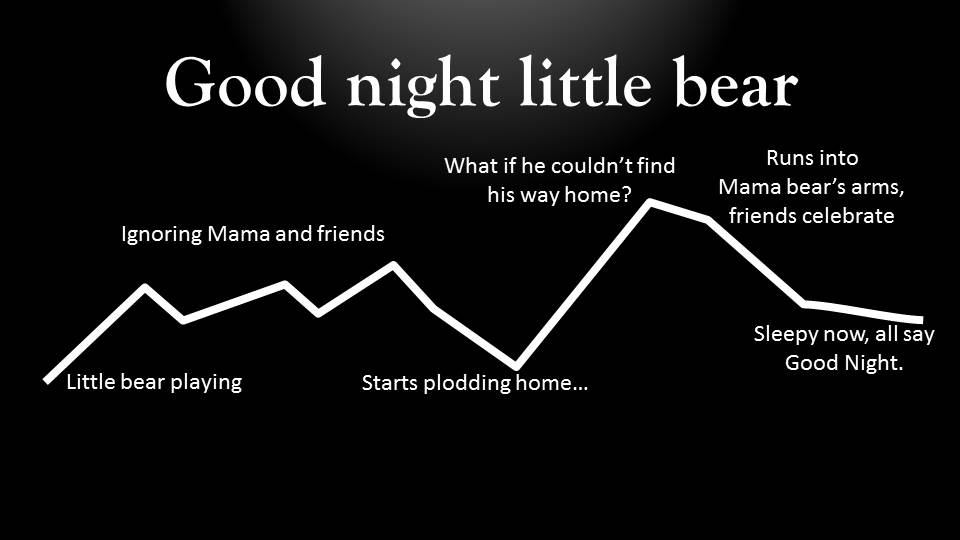
Good Night, Little Bear is much more interesting. We read this to David almost every night, and even though it doesn’t have crinkly pages, he still seems to really enjoy it. The story is (essentially) little bear not wanting to go to bed, instead he goes off to play, until eventually he watches the sunset, it gets dark, and he realises he should have listened to Mama bear, and in fact he’s lost now and can’t find his way home. But then Mama bear, assisted by Little Bear’s friends, Mouse and Squirrel, come to find Little Bear. He hears them calling him, and runs to Mama Bear’s arms. He’s now feeling tired, and goes to bed. It’s really well told, with lovely pictures, and so on.
A much more complex rough energy flow chart.
So that’s the “energy flow” concept. Reasonably simple to grasp. If we are making an event which is a variety show / sandwhich programme, or a concert, then it’s worth thinking about this stuff, and saying “How do we want to start? Something big and fun to grab the attention, and then we can settle down a bit, work our way up to a climax, and then slowly bring it to a close…”.
It’s so lovely being back at sea, and David seems to quite like it too. He actually slept right the way through the night the first night! Amazing… (If only he’d do it again…)
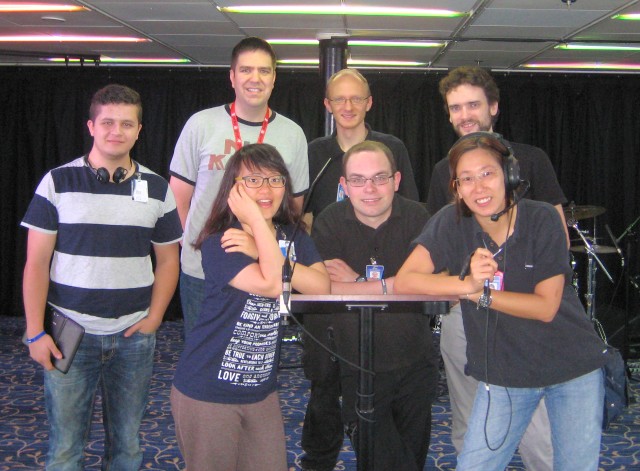
AV work is going reasonably well. We’re doi ng loads of training, as much as possible, but still trying to get everything working again too. It’s really hard trying to arrange work for people to do, who know nothing about A/V at all, and may not have even touched a sound, lighting, or video console before joining the team. Still, they’re all great people, and we’re having a lot of fun.
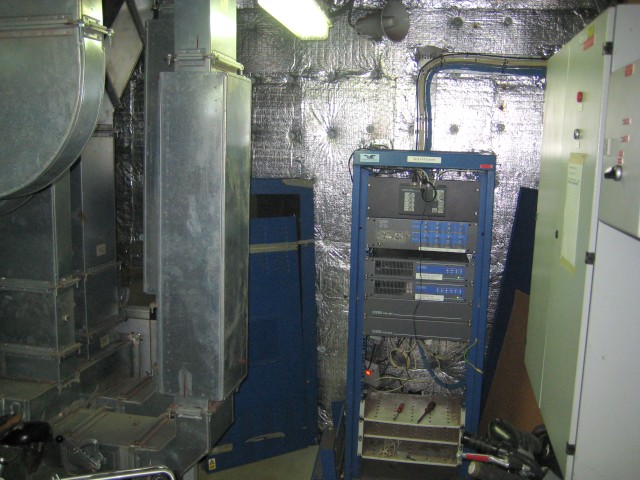
One very frustrating thing was that I had to fix the Deck 4 music and paging system. For whatever historical reason, that’s part of A/V’s responsibility, rather than the electricians. The rack is located in a loud noisy fanroom, full of dust and grime.
The rack isn’t very accessible, and getting in to the wires is really really awkward and scrapey.
It’s not massively well documented (another task on my list…), and I think several people had tried to fix it recently, so all the settings were messed up. In the end, I pulled out the entire system, took it down to our storeroom to clean and test and set up, and then brought it back and plugged it in. It all worked! Which was great. It just then took ages of walking around with the team getting them to tell me which zones were connected and had the right volumes, and so on. Not fun, and as it needs to be working before we arrive in the next port, it meant I had to do that for 4 days rather than work on any of our venues. Grrr…
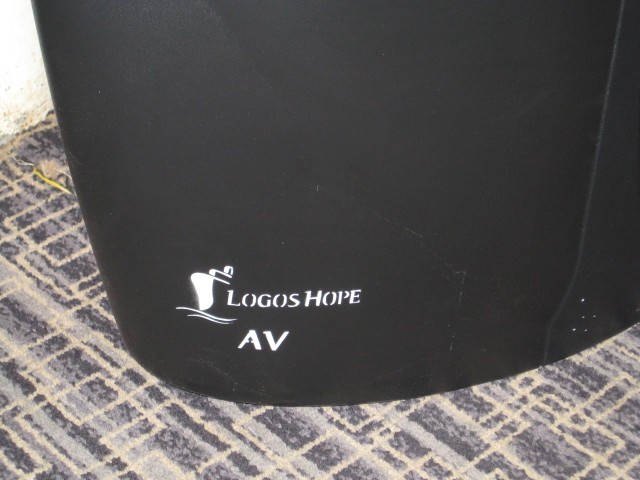
The new portable ‘fender’ sound systems that we bought are a huge success. They work really well. I asked one of the new A/V team to paint ‘Logos Hope A/V’ on the side of them all so that they don’t get lost, or apprehended into some other department. I was expecting something ugly but functional. Instead I got this:
Really cool!
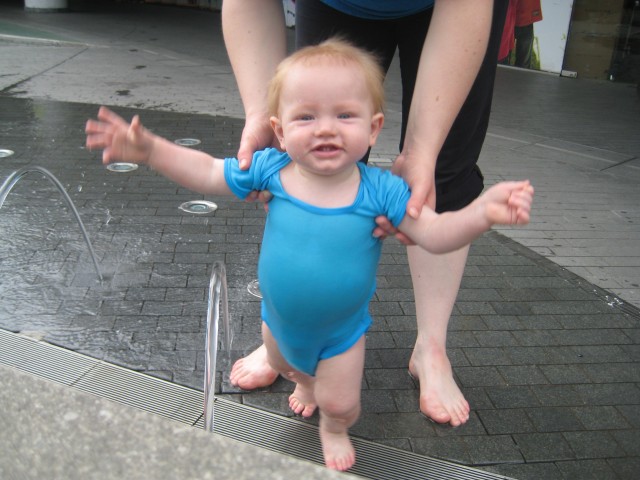
Anyway, to end this post, here’s a photo of David from when we took him to the kids water zone at the mall in Singapore. Wet as a fish, a nappy as wet as he, and as Becky puts it, “Happy as Larry”. (Whoever Larry is…)
We just had a pretty awesome day off. We woke up pretty late. Well, that is to say David woke up very early, and we were too tired to try and persuade him to sleep in his cot again, so he came to join us in bed for a couple more hours. Eventually we all got up, and had a bit of breakfast.
I then went to the galley to get some supplies (icing sugar, cocoa powder, carrots, pears, and dry pasta) for us to make cakes for some of our ‘ship family’ birthdays coming up, the rest for making food for David. You can guess which ingredients are for which activity.
I then took David to run around and play in the Logos Lounge, while Becky did some laundry. We then had lunch, and then (finally) got around to giving David his first toothbrush, and first teeth brushing!
We next headed out by MRT to the Singapore Botanical Gardens. It was lovely - really peaceful and green, but extremely well paved and buggy friendly. We found a somewhat random statue of Chopin,
we managed to prop up the camera on the buggy for a family photo too:
David wasn’t totally convinced by all the shots, though:
We spent a few hours there, and headed back. We bought a couple of extra bits from the supermarket, and got back just in time for dinner. On the way through the mall, Mini were giving out free balloons - so David got his first balloon as well!
At Dinner, our friend Maria, one of the new AV team, came and sat at our table and said, “So, we’re playing settlers tonight, right?”
So we went up to the cabin, and had a lovely game of Settlers of Catan! David loved it, and for some reason went in to giggles almost every time Maria rolled the dice for the first half of the game! Funny boy.
We finished the game - Becky won, with 10 points (short game), by stealing the longest road from me and Maria would have won on her turn, again, by stealing my longest road. We were just about to pack away, when Becky looked really puzzled, and realised that I should have won the previous round, as I also had 10 points (I’d forgotten about a hidden victory point)!